Julius AI
ai-data-analysis
Julius AI, an AI data analysis tool, divides the room. Ask a PhD student grinding through dissertation regressions and you'll hear genuine relief: it debugs its own Python code and handles iterative analysis without requiring users to write manually. Ask a professional data scientist and you'll hear dismissal. The community consensus is that it's probably only good for generating ad hoc charts for PMs and non-technical users. Both reactions are accurate. Julius is not a data science tool pretending to be something it isn't. It is a statistics assistant built for the large population of researchers, social scientists, and non-technical professionals who need analysis done but cannot write the code to do it. That population is real, it is active, and Julius AI pricing has a free tier plus paid Pro plans with database connectors.
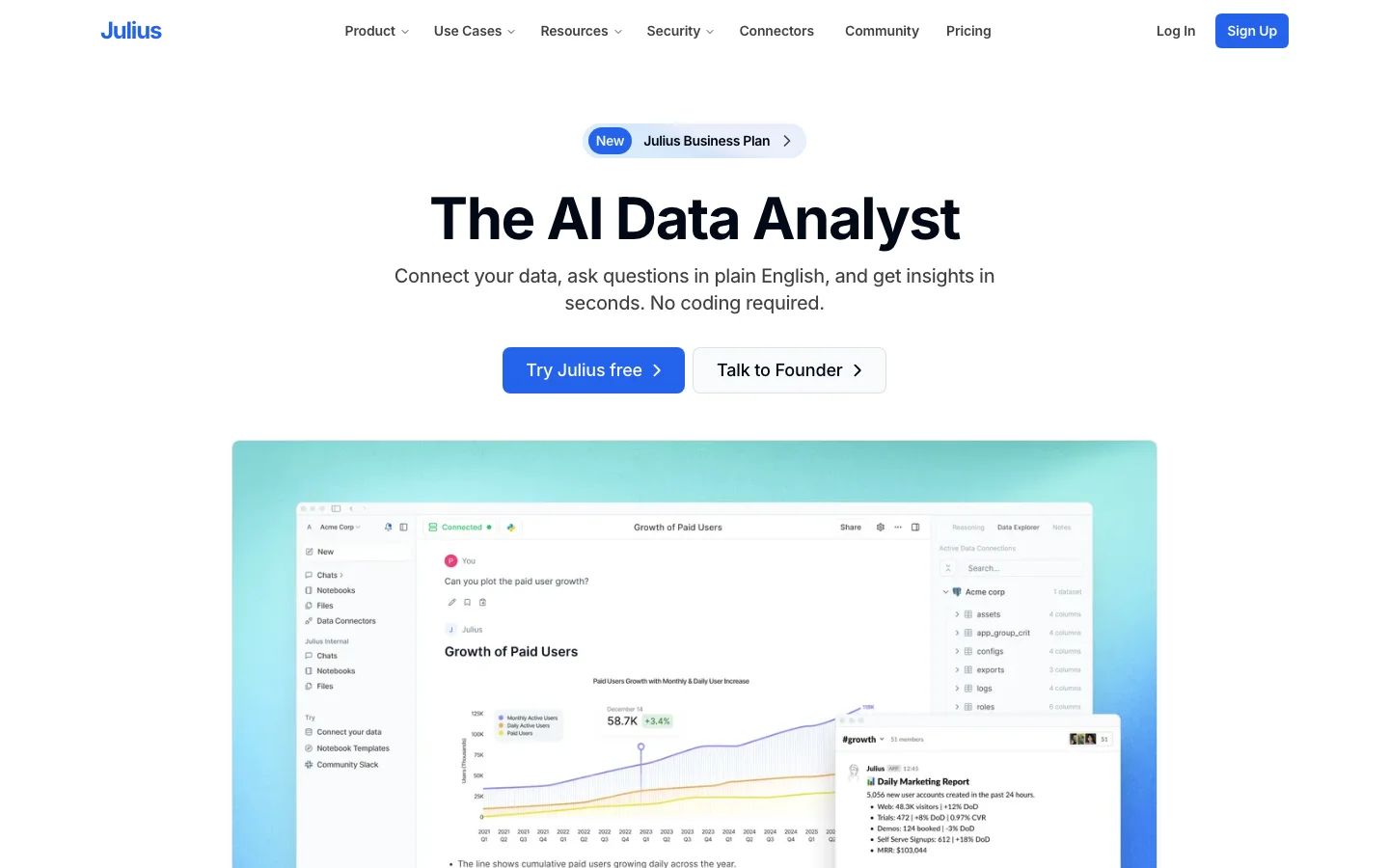
The tool's core loop is deliberately simple: upload a CSV or connect a database, ask a question in plain English, and get a chart or statistical summary back in seconds. Julius writes and executes Python behind the scenes, self-debugs when the code fails, and returns clean output without requiring you to know what pandas is. Its Notebooks product extends this into a persistent, collaborative workspace where teams mix natural language prompts with auto-generated code and visualizations. In practice, regular users say the iterative chat interface works well for academic stats work: the back-and-forth of "now run a chi-square" and "break it down by cohort" feels native in Julius in a way a general-purpose chat thread does not.
The limits are real and worth naming clearly. In a Julius AI vs ChatGPT Code Interpreter comparison, both handle the same jobs; Julius costs extra unless the UX for iterative academic stats justifies it. More critically: Julius requires uploading your data to its servers, which is a Julius AI data privacy limitation. For anyone under IRB approval, GDPR, or corporate governance, that is a structural blocker, not a preference. Community members in research subreddits flagged this sharply: "I hope you aren't doing this with identifiable data." One additional flag worth transparency: Julius has $8M in seed funding and a hiring controversy: a job posting promised a $4K/week contract to extract product strategy from applicants with no intent to hire, circulating on r/recruitinghell with 86 upvotes. It does not affect the product's functionality, but it is a company ethics signal that readers doing due diligence will encounter.
Julius AI is listed in the AI data analysis tools category. It also appears in our best AI tools for small business guide as a pick for operators who need lightweight data analysis without a data science background.
Frequently Asked Questions
Is Julius AI legit and safe to use?
Julius AI is a legitimate, seed-funded ($8M) data analysis product with real production users: IO psychologists, PhD students, and non-technical analysts who use it for genuine statistical work. One documented credibility concern: a r/recruitinghell thread (score 86) alleged Julius used a job posting to extract free product strategy from candidates with no hiring intent. For data safety, Julius AI operates on a cloud-upload model, which means your data leaves your environment. This is a hard block for IRB-regulated research, GDPR contexts, and corporate data governance. It is not a preference issue; it is the product's architecture. Evaluate this constraint before any sensitive data workflow.
How much does Julius AI cost in 2026?
Julius AI offers a free tier with limited monthly queries and a Plus plan for individual analysts. Pro and Teams plans add database connectors (Snowflake, BigQuery, PostgreSQL), advanced reasoning mode, and live collaboration. The Max tier includes access to all models including Claude Opus 4. Custom Enterprise pricing is available for organizations needing on-premise data governance or unlimited usage. Verify current plan pricing at julius.ai. The tier structure and model availability have evolved since launch.
Is Julius AI worth the subscription?
For non-technical users (PhD students, IO psychologists, operations managers) who need to run legitimate statistical analysis without Python or R, Julius AI is genuinely useful. The self-debugging execution loop (writes code, runs it, catches errors, retries without user intervention) is the feature that earns the most organic praise, and it differentiates Julius from manually prompting ChatGPT for analysis. For data professionals and engineers, the answer is clearly no. The r/datascience consensus is that Julius is primarily for non-technical users, and ChatGPT Code Interpreter handles most of the same tasks for anyone already paying for ChatGPT Plus.
Does Julius AI have a free trial or free plan?
Yes, Julius AI has a free tier that allows you to upload a CSV and run analysis queries without a credit card. The free tier limits the number of monthly queries and the context size (2,400 characters vs. 10,000 on Max/Enterprise). It is enough to test whether the interface matches your workflow. Upload a real dataset you work with and run a few analyses. If the free tier's query limit is too restrictive for proper evaluation, the Plus plan is the natural next step.