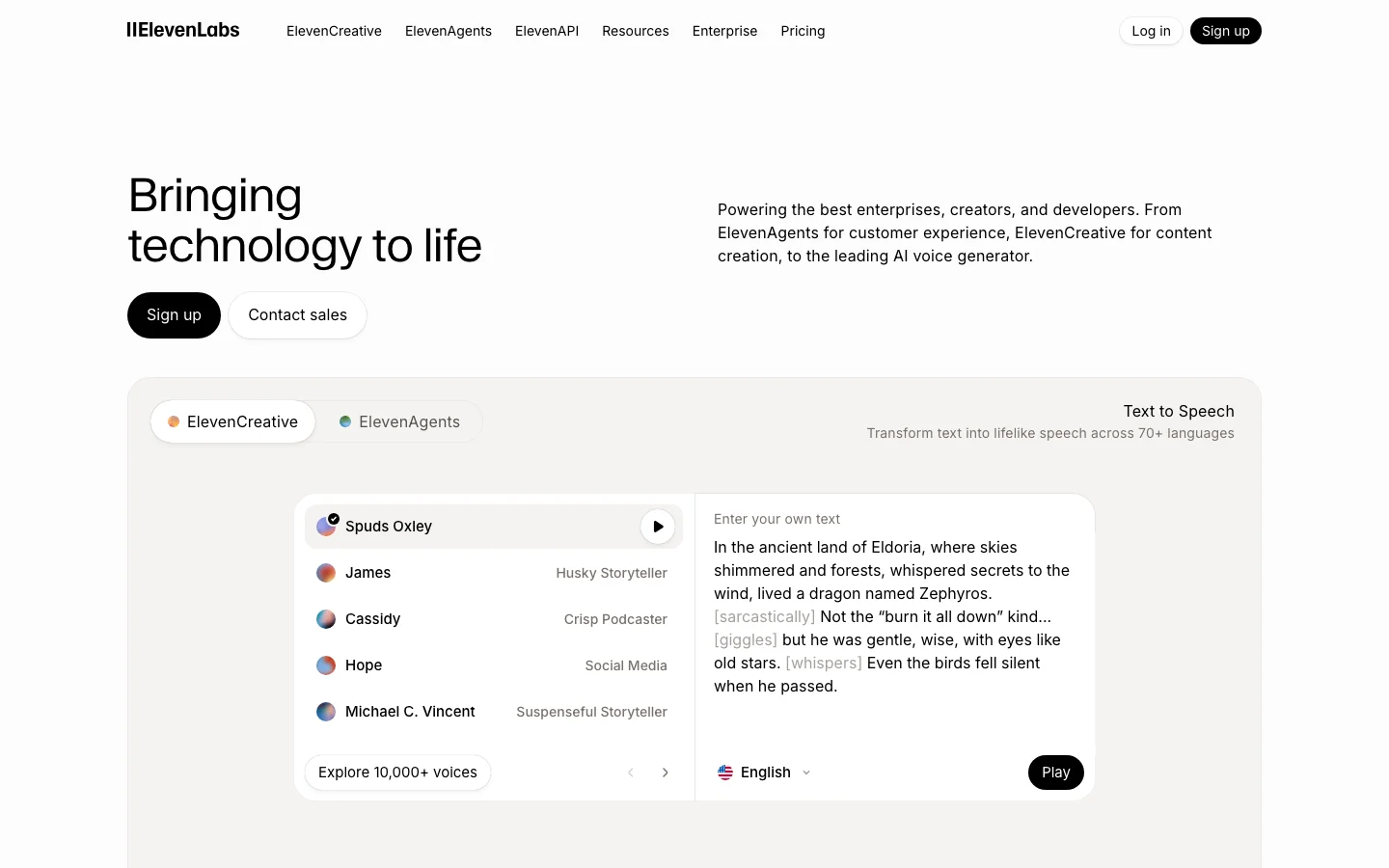

ElevenLabs is the quality benchmark for AI text-to-speech, and that sentence is not marketing copy -- it is just how the market is positioned. Every competitor in the AI voice generation category is defined by how close it gets to ElevenLabs. Not the other way around. We have tested a lot of voice tools across this category, and the gap at the top is real. The Eleven v3 model handles emotional range, accent control, multi-character dialogue, and symbol reading -- numbers, URLs, phone numbers -- at a level that nothing else in cloud TTS currently matches. An indie filmmaker cloned an actor's voice from 20 minutes of clean dialogue and used the output for ADR in a production film. A Skyrim modding community called the v3 upgrade "massive" for narrative emphasis and multi-character scenes. These are production users publishing results publicly, not beta testers praising a press release. One meaningful update entering 2026: ElevenLabs expanded the Creator plan character allowance from 110,000 to approximately 440,000 characters per month on Flash and Turbo models. That changes the value calculation for mid-volume creators who previously found Creator too limiting. The tool that was cost-competitive only for lower-output users is now viable for substantially higher monthly volumes. What Makes ElevenLabs Different Voice quality is the obvious answer, but it understates what is actually happening at the model level. The Eleven v3 model produces output that handles prosody -- the rhythm, stress, and intonation of natural speech -- in a way that other TTS systems approach but do not match. The practical effect: ElevenLabs narration holds listener attention longer because it does not sound like narration. It sounds like a person speaking with intent. The Voice Library marketplace is a differentiator with no direct equivalent in the category. Voice clone creators upload their voices, set a royalty rate, and earn passive income per 1,000 characters generated using their voice. Multiple creators have confirmed payouts exceeding $1,000 over five months from a portfolio of eight clones. This creates a revenue angle that makes ElevenLabs interesting not just as a tool but as a platform with network effects. The developer ecosystem is the third differentiator that matters. The full REST API on Creator plan and above gives programmatic access to voice generation, voice cloning, speech-to-speech, and conversational AI. No other TTS tool at this price point has the same API surface area. The MCP server integration -- which enables ElevenLabs voices to be called directly from Claude and other AI assistant workflows -- is something no competitor currently offers. ElevenCreative and ElevenAgents have expanded significantly through 2026. ElevenCreative now includes Music Generation alongside voice, positioning ElevenLabs as a broader audio platform. ElevenAgents supports production phone agent deployments with SIP trunking, batch calling, Pronunciation Dictionaries, and webhook-driven workflows -- a full conversational AI platform built on top of the TTS core. If you are building a voice-first product, ElevenLabs is the platform, not just the API. ElevenLabs Pricing 2026: Every Plan Explained ElevenLabs pricing in 2026 runs from $0 (Free) to $990/month (Business), with a custom Enterprise tier above that. Starter at $6/month is the entry point for commercial use. The Free plan covers non-commercial work only. Plan Monthly price Characters/mo Seats Key feature Free $0 10,000 1 Non-commercial only. No voice cloning. Hard cap at 10K chars. Starter $6/mo 30,000 1 Commercial license, Instant Voice Cloning, API access, 20 Studio projects. Creator $22/mo ($11 first month) 121,000 (standard models; ~440,000 on Flash/Turbo at 0.5 credits/char) 1 Professional Voice Cloning (1 slot), 192 kbps output, overage billing enabled. Pro $99/mo 600,000 1 44.1 kHz PCM output, priority processing, 160 custom voice slots. Scale $299/mo 1,800,000 3 3 workspace seats, 3 Pro Voice Clones, team collaboration features. Business $990/mo 6,000,000 10 Low-latency TTS endpoint, 10 Pro Voice Clones, 10 seats. Enterprise Custom Negotiated Custom HIPAA BAAs, custom SSO, SLAs, dedicated support. Credits roll over for up to 2 months (maximum balance: 3x your monthly quota). They are shared across all ElevenLabs products: TTS, speech-to-text, dubbing, and sound effects. Flash and Turbo models consume 0.5 to 1 credit per character; Multilingual v2 and v3 models consume 1 credit per character. That difference matters when planning your monthly usage. Annual billing discounts exist for Pro and Scale. Specific annual figures are not surfaced on the official pricing page, so those rates are not stated here. Check elevenlabs.io/pricing for current annual pricing before committing. What changed in November 2025 ElevenLabs went through three pricing restructurings in 2025, which explains the volume of "elevenlabs pricing" searches. In January 2025, credits were split by model, creating billing confusion. August 2025 reunified credits across models. The most significant change came in November 2025: Conversational AI / Agents minutes shifted from pure per-minute billing into the plan structure at each tier. If you use ElevenAgents for phone or voice chatbot applications, that change affects how your usage is billed. In December 2025, ElevenLabs also cut API and Agents pricing substantially, with Flash model costs dropping by roughly 55% for API usage. Which plan do you actually need? Free works for evaluation and non-monetized personal projects. The moment you put audio on a monetized YouTube channel, sell an audiobook, or use ElevenLabs output for client work, Starter at $6/month is the minimum. Creator at $22/month is the practical choice for most individual content creators: 121,000 characters per month at standard quality, Professional Voice Cloning (one slot), full API access, and commercial rights. The first month is available at 50% off ($11), making it low-risk to test. Pro at $99/month makes sense for high-volume producers, developers who need broadcast-quality 44.1 kHz PCM output, and production studios where processing speed matters. Scale at $299/month adds two extra seats and roughly 3x the character quota versus Pro. It is the first team tier. Hidden costs on ElevenLabs Four things the pricing page does not make obvious: Overage billing on Creator and above. Free and Starter plans hard-cap at their character limits. Creator, Pro, Scale, and Business allow overages. Rates vary by model. Variable production months create unpredictable bills. Model credit rates differ. Flash v2.5 uses half the credits of Multilingual v2. Using a higher-quality model by default can exhaust your monthly quota faster than expected. LLM costs on Agents are separate. When using ElevenAgents with GPT-4, Claude, or another LLM backbone, you pay the LLM provider separately through your own API keys. The ElevenLabs plan covers voice synthesis only. Professional Voice Cloning requires real recording time. Creator gives you one PVC slot. The quality that makes PVC worthwhile requires roughly 30 minutes of clean audio and multiple processing rounds. A 2-minute clip produces Instant Voice Cloning fidelity, not PVC fidelity. Switching from PlayHT to ElevenLabs? PlayHT discontinued data exports on December 31, 2025, with accounts locked in 2026. ElevenLabs is the most common migration target. For equivalent commercial functionality, Creator at $22/month covers the voice quality and cloning capability that PlayHT's paid tiers provided, with a more mature developer API and a larger voice library. Instant Voice Cloning means you can recreate a voice from a recording sample without waiting for the Professional Voice Cloning pipeline. ElevenLabs Pricing: Is It Worth It? A lot of people arrive here after searching for ElevenLabs alternatives. At $22/month for the Creator plan, ElevenLabs is not free and not cheap. One Reddit thread in r/ElevenLabs titled "ElevenLabs is killing my budget" collected 241 upvotes and 181 comments in the past year. The frustration is real and widely shared. Before writing it off on price, here is where the money actually goes. The v3 model produces voice output with prosody, emotional range, and accent control that no competing cloud TTS product currently matches at this price point. That gap matters most for two use cases: voice cloning and long-form narration where the output will face a real audience. If you are producing audiobooks, podcast episodes, YouTube narration, or documentary voiceover, listeners will notice the difference. If you are generating error messages for a software UI, they probably will not. The credit system is the legitimate source of frustration. Character-to-credit conversion varies by model, which creates planning friction. The v3 model is non-deterministic: the same input can produce noticeably different output on consecutive generations, so batch workflows for audiobooks or training series require QA time and regeneration budget. That is a real cost on top of the subscription fee. One update that changes the value calculation for mid-volume creators: ElevenLabs expanded the Creator plan to approximately 440,000 characters per month on Flash and Turbo models. That is enough for a full audiobook per month, a weekly podcast with room to spare, or consistent YouTube narration at volume. The first month is available at 50% off ($11 instead of $22), making evaluation low-risk. If the price does not work for your volume or budget, here are the alternatives worth your time: Murf AI ($19/month annual, or $29/month on monthly billing): cleaner billing model, predictable generation hours, no credit anxiety. The voice quality is below ElevenLabs but solid for corporate e-learning, training modules, and business narration. The right call if you need a team workflow and do not need expressive narration or voice cloning. Lovo AI (Genny) ($24/month, paid plans): TTS plus a built-in video editor, stock footage library, and AI scriptwriter under one subscription. The English naturalness ceiling is lower than ElevenLabs, but if you are currently paying for four separate tools to produce narrated video content, the consolidation saves money. Note the active class action lawsuit context in our full voice generator comparison. Vozo AI: aimed at video dubbing and translation workflows rather than standalone TTS. Worth evaluating if your use case is primarily video redubbing rather than original narration. For users who are not ready to pay at all, see our free AI voice generator guide. It covers what the free tiers of ElevenLabs and alternatives actually give you, including the limits you will hit within the first week of production use. The honest summary: ElevenLabs is the correct answer if voice quality matters and you produce content at $22/month scale or above. It is not the correct answer if you need predictable flat-rate billing, an all-in-one video tool, or a free tier that handles real production volume. The alternatives above cover those cases. See the full ElevenLabs vs Murf AI breakdown for a head-to-head comparison. ElevenLabs Pricing FAQ How much does ElevenLabs cost per month? ElevenLabs plans run from $0 (Free) to $990/month (Business), with custom Enterprise above that. Starter is $6/month and is the minimum tier for commercial use. Creator at $22/month (first month $11) is the most common choice for individual creators. Is ElevenLabs free? There is a permanent Free plan with 10,000 characters per month. The Free plan is non-commercial only. You cannot use free-tier output on monetized YouTube channels, for client work, or in products you sell. For commercial use, Starter at $6/month is the entry point. What is the cheapest ElevenLabs plan for commercial use? Starter at $6/month. It includes 30,000 characters per month, a commercial license, Instant Voice Cloning, and API access. What happened to ElevenLabs pricing in 2025? Three restructurings: January 2025 split credits by model and created billing confusion. August 2025 reunified credits across models. November 2025 moved Conversational AI / Agents from pure per-minute billing into the plan tier structure. December 2025 cut Flash model API costs by roughly 55% and introduced pay-as-you-go for the API. Is ElevenLabs worth it vs Murf AI on price? Murf AI charges $19/month on annual billing, or $29/month on monthly billing. ElevenLabs Starter is $6/month but covers lighter use; Creator at $22/month is the real comparison point for Murf Creator. The $3 gap between them is not the meaningful question. ElevenLabs charges by character with overage rates; Murf charges by generation hours, which is more predictable for steady-volume work. On voice quality, ElevenLabs wins. For L&D teams producing consistent batch training content, Murf's model is often more economical. For variable production or audience-facing content, ElevenLabs Creator is competitive. See the full ElevenLabs vs Murf AI breakdown. What happened to PlayHT? PlayHT discontinued data exports on December 31, 2025, and accounts were locked in 2026. ElevenLabs has become the default migration destination for former PlayHT users. Creator at $22/month covers equivalent voice cloning and commercial use capability. ElevenLabs vs Murf AI In head-to-head testing against Murf AI, ElevenLabs wins on voice quality and emotional range without contest. Murf wins on interface simplicity, predictable billing, and e-learning workflows. The quality gap is real and verifiable. Running the same narration scripts through both tools across corporate explainer, emotional narrative, and technical documentation categories, ElevenLabs won all three. The gap is most visible in emotional content -- ElevenLabs can hit genuine warmth, urgency, and authority in the same voice. Murf's voices are clean and consistent, but "corporate" is the word that appears constantly in community feedback for a reason. Where Murf makes a legitimate argument: L&D teams producing corporate training modules at steady monthly volume. Murf's $19/month pricing charges by audio hours generated rather than characters, which is more predictable for batch production. The built-in video editor means you can go from script to voiced video without a separate NLE. For that specific workflow, the case for Murf is real. Check Lovo AI if you want a middle-ground option with strong studio workflow features. For developer access, voice cloning, and expressive narration, ElevenLabs is not a close call. Our detailed breakdown is in the AI voice tools comparison. Against Vozo AI and other budget alternatives: Vozo targets the lower-cost segment with flat-rate pricing and no credit anxiety. For creators who need consistent monthly output without QA overhead and do not require voice cloning or developer API access, Vozo is worth evaluating. ElevenLabs wins on output quality; Vozo wins on billing simplicity at lower price points. Is ElevenLabs Worth It in 2026? For most users who need high-quality voice output commercially, yes -- and the case is stronger in 2026 than it was in 2025. The Creator plan at $22/month is the pivot point. At roughly 440,000 characters per month on Flash/Turbo models, you can produce a full-length audiobook per month, a weekly podcast series with room for experimentation. The first month at $11 makes evaluation nearly free. Commercial license is included at Creator and above. Instant Voice Cloning means you can have a custom voice on the platform in minutes. The criticisms are consistent and worth taking seriously before you subscribe. The v3 model is non-deterministic -- the same prompt can produce excellent output one generation and noticeably off output the next. For batch workflows producing 40 to 60 files for an audiobook or training series, that QA burden adds up. Budget time for regeneration and review cycles in long-form production. Voice drift in large batches is documented. ElevenReader's 2025 paywall rollout was poorly handled and damaged trust with power users. Open-source alternatives including Kokoro, F5-TTS, and Orpheus are closing the quality gap and are a credible long-term cost alternative for developers who can self-host. For podcasters, audiobook authors, content creators, and developers building voice-first products, ElevenLabs is the correct answer in 2026. For corporate e-learning teams that need predictable billing and do not require expressive narration or voice cloning, Murf AI is a legitimate alternative worth evaluating. For budget-sensitive creators who primarily need basic TTS without voice cloning, the Starter plan at $6/month or the expanded free tier may cover your needs. Frequently Asked Questions How much does ElevenLabs cost in 2026? Free plan includes 10,000 credits per month. Starter is $6/month (30,000 credits). Creator is $22/month (121,000 credits, approximately 440,000 characters on Flash/Turbo models). Pro is $99/month (600,000 credits). First Creator month is available at 50% off. Verify current pricing at elevenlabs.io/pricing. Is ElevenLabs worth $22 per month? For most creators doing commercial voice work, yes. The Creator plan at $22/month includes approximately 440,000 characters per month on Flash/Turbo models (up from 110,000 previously), commercial license, Instant Voice Cloning, and Voice Library marketplace access. The first month at $11 makes evaluation low-risk. If you need expressive narration, voice cloning, or developer API access, Creator is the correct starting point. How does ElevenLabs compare to Murf AI for podcasters? ElevenLabs is the better choice for podcasters who need expressive narration and voice cloning. The Creator plan's character allowance covers a full monthly podcast slate with room for experimentation. Murf is better for corporate e-learning teams that need predictable billing and built-in video editing. For narration quality that holds listener attention, ElevenLabs wins this comparison clearly. What are ElevenAgents and ElevenCreative? ElevenAgents is ElevenLabs' conversational AI and phone agent platform, supporting production deployments with SIP trunking, batch calling, Pronunciation Dictionaries, Guardrails 2.0, and webhook-driven workflows. ElevenCreative is the broader creative platform that now includes Music Generation alongside voice. Together they position ElevenLabs as a full audio AI platform, not just a TTS API. Is voice cloning legal and what are the consent requirements? ElevenLabs requires users to confirm they have the rights and consent to clone any voice before saving a clone to the platform. Cloning your own voice is straightforward. Cloning another person's voice without their consent violates ElevenLabs' terms of service. Celebrity voice licenses (Michael Caine, Matthew McConaughey, and others) are available through ElevenLabs' official partner program under commercial terms. For any professional application, read the Terms of Service and AI Safety guidance at elevenlabs.io.
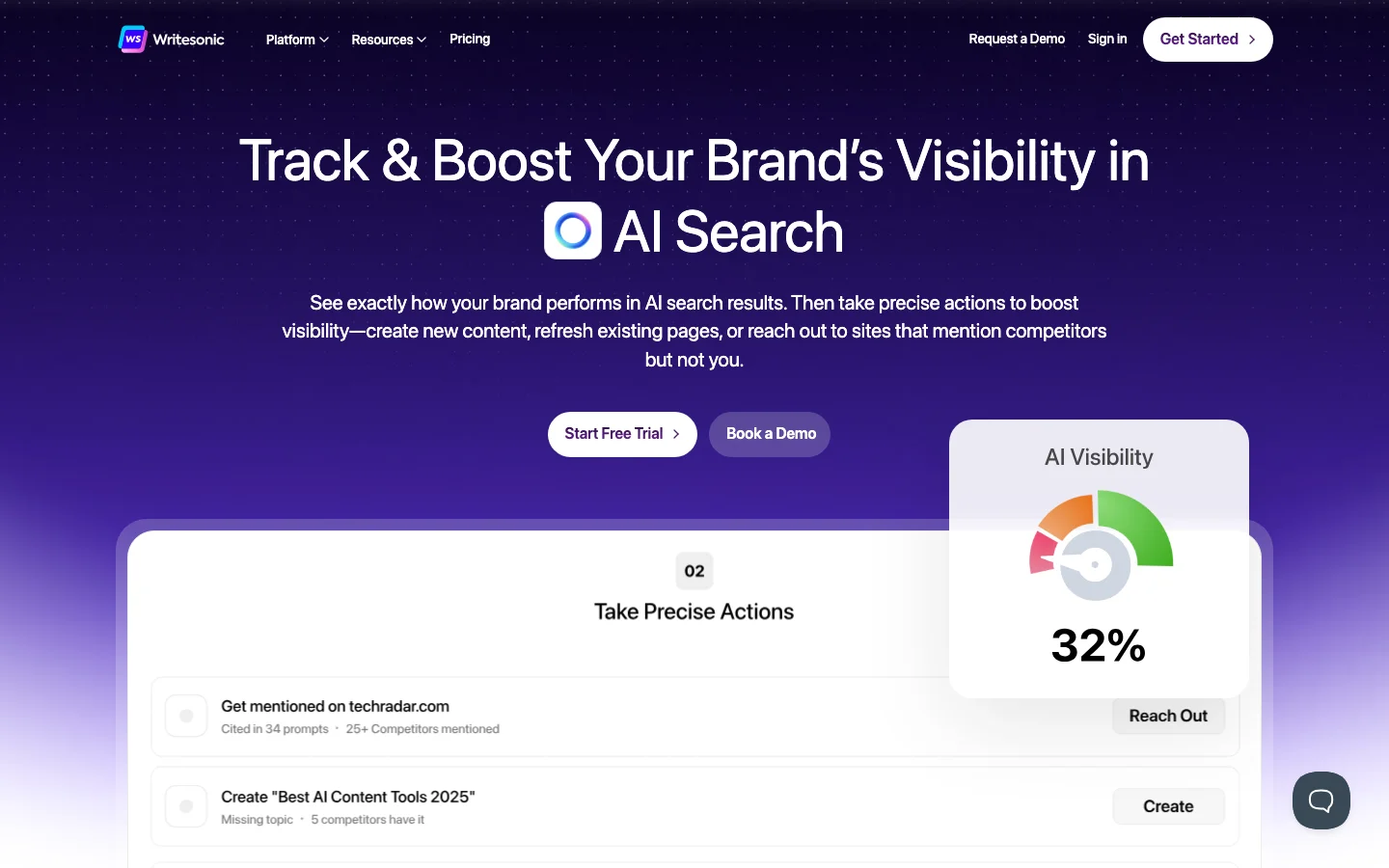

Writesonic is a GEO (Generative Engine Optimization) and AI writing platform used by marketing agencies to track brand mentions in ChatGPT, Perplexity, Google AI Overviews, and a growing list of AI search engines. It started as an AI writing tool in 2021, but its 2025-2026 pivot changed the product fundamentally: brand visibility in AI search is now the headline, with SEO content tools and an AI chatbot bundled in. The GEO dashboard tracks where your brand appears in AI-generated answers, what sentiment surrounds those mentions, and what to do about it through an Action Center. The $399/month Growth plan (billed annually) bundles this with an SEO toolkit that includes article generation, site auditing, and Chatsonic, the AI chat interface that now supports GPT-4o and Claude 3.7 Sonnet. Agency users report leads telling clients they found them through AI search, with the Action Center called out specifically for knowing what to fix. The AI writing product is still present: long-form article generation, Chatsonic with live web access, brand voice training, bulk generation. The honest picture from real users is that writing output has a persistent stiffness that prompting cannot reliably remove. Users describe it as solid for rough drafts and idea angles, not publish-ready copy. If your goal is writing quality alone, ChatGPT or Claude used directly outperform Writesonic's output. The development focus has shifted toward GEO, and the writing tools reflect that. What Makes Writesonic Different in 2026 The core differentiation is GEO tracking depth. Writesonic now monitors brand visibility across ChatGPT, Perplexity, Google AI Overviews, Google AI Mode, Claude, Gemini, Microsoft Copilot, Grok, DeepSeek, and Meta AI. That is a wider AI platform coverage than most competitors at this price point. The Action Center is what makes this tracking useful rather than decorative. It generates Prompt Diversification strategies using SEO keywords pulled from Ahrefs, Reddit, and People Also Asked, so you are not just watching your visibility score drop but actually getting directions for improving it. The Prompt Explorer maps how ChatGPT Shopping results are surfacing products in your category, which is a genuinely different data layer for e-commerce brands and agencies. Chatsonic has been upgraded significantly for 2026. It now supports model switching between GPT-4o and Claude 3.7 Sonnet inside the same session, with web browsing, file uploads, image generation via ChatGPT Image and Flux 1.1, and data integrations pulling from Google, Ahrefs, and Semrush. That positions it as more than a standard AI chatbot: it is a research and analysis workspace with SEO context built in. The SEO site audit has AI-powered automatic fixes, not just issue flagging. Growth plan users get 2,500 pages analyzed per audit with 50 audits per month. The SEO Content AI Agent generates articles with unlimited runs on paid plans. For agencies managing multiple clients, the Projects and Team structure lets you isolate client environments within a single subscription. The competitive field for GEO is active. Profound is the enterprise market leader but priced above what most agencies can justify. Guzu.ai is cheaper with comparable charts. SearchParty sits at a similar price point. Writesonic's clearest moat is the Agency Partner Program: 20% recurring commissions, exclusive features, and pitch support. That has built a real advocate layer in marketing communities that pure feature comparisons do not capture. Writesonic Pricing Plans 2026 Writesonic restructured its pricing significantly for 2026. The old $299 agency tier is gone. The current plan structure is: Free: Limited article generation, no GEO tracking, Chatsonic access with model limits. Not viable for evaluating the core GEO product. Useful only for a quick test of the writing interface. Starter: $99/month ($79/month billed annually). 50 AI prompts tracked (ChatGPT only), daily tracking frequency, 1 region, 1 language. 15 article generations per month, 10 site audits, 100 pages analyzed. Chatsonic with GPT-4o and Claude 3.7 Sonnet. Suitable for early-stage brands building initial AI search presence. Basic: $249/month ($199/month billed annually). Expanded GEO tracking across ChatGPT, Google AI Overviews, and Gemini. More article generations and audit capacity. Adds 2 additional user seats at $50/seat. Growth: $499/month ($399/month billed annually). 200 prompts tracked daily across ChatGPT, Google AI Overviews, and Gemini. 50 article generations per month, 50 audits, 2,500 pages analyzed. 5 portfolio tracking groups. Up to 5 additional seats at $60/each. This is where the full GEO and SEO bundle becomes viable for agencies running multiple client campaigns. Enterprise : Custom pricing: Custom prompt volume, tracking frequency, regions, languages. Includes a dedicated GEO strategist and Slack or Teams support. For brands running AI visibility campaigns across multiple markets. Billed annually, the Growth plan works out to $399/month. For agencies that would otherwise pay separately for a GEO monitoring tool and an SEO suite, the bundling argument holds. Verify current pricing at writesonic.com/pricing, as the tier structure has shifted multiple times in the past 18 months. Writesonic vs Alternatives For GEO tracking specifically, the comparison set is Profound (enterprise, higher cost), Guzu.ai (cheaper, strong on chart features), and SearchParty (similar price, less bundled). Writesonic differentiates on the SEO content bundle and the Agency Partner Program rather than raw GEO feature depth alone. For AI writing quality, Jasper AI has invested more in workflow integration and Brand Voice consistency. Jasper is the better choice if your team's primary need is on-brand content operations at volume. Writesonic's writing output is useful for drafts but requires editing to be publish-ready, which Jasper also requires but with stronger brand controls to guide the output. Copy.ai pivoted to B2B sales automation and is no longer a relevant comparison for GEO or content writing use cases. If AI search visibility tracking is the goal, Writesonic is the practical mid-market option. Browse the full AI writing tools category for a complete comparison across price points. Is Writesonic Worth It in 2026? For agencies tracking brand visibility in AI search, Writesonic delivers real value at the Growth tier. Sentiment analysis and visibility tracking are specifically praised by agency users for being actionable, not just informational. The bundled SEO content tools and Chatsonic with GPT-4o and Claude 3.7 Sonnet access make the subscription defensible if you are replacing separate tools. For teams whose primary need is AI writing quality, the math is harder to justify. Chatsonic with GPT-4o access works, but the standalone article writer requires editing before publication. ChatGPT or Claude used directly costs less and produces output that requires similar editing effort. The GEO dashboard is what makes Writesonic worth the premium, not the writing capability. The agency churn risk is real. Users testing all GEO competitors simultaneously means loyalty is conditional on the feature-to-price ratio holding as Guzu, SearchParty, and eventually Ahrefs mature. If GEO tracking is central to your agency's service offering, Writesonic is a workable bet at current pricing. If GEO tracking is exploratory, start at Starter to validate before committing to Growth. Frequently Asked Questions Is Writesonic better than Jasper or Copy.ai? For GEO and AI search tracking, Writesonic is the only one in this comparison that offers it as a core product. Jasper AI is the better choice for on-brand content operations with team workflows. Copy.ai pivoted to B2B sales automation and is not a relevant writing tool comparison. The tools serve different primary jobs in 2026. How much does Writesonic cost in 2026? Plans run from free to $499/month. The Growth plan at $399/month billed annually is the practical entry point for agencies needing full GEO tracking. Starter at $79/month annually covers early-stage brands. A free trial is available. Verify at writesonic.com/pricing. Does Writesonic generate factual content with sources? Chatsonic, Writesonic's AI chat tool, includes real-time web browsing and pulls sources. The AI Article Writer generates content from training data without real-time sourcing by default. For factual research workflows, Chatsonic with web access is the relevant product. The article writer requires manual fact-checking before publication. Can I use Writesonic for SEO articles? Yes. All paid plans include the SEO Content AI Agent for unlimited article generation runs and a site audit tool with AI-powered fixes. The Growth plan allows 50 full article generations per month. Output quality is suitable for drafts and outlines; it typically needs editing before publication. The GEO-focused plans also include keyword research and content strategy tools. Is there a free plan? Yes, but it is limited. The free plan provides restricted article generation and no access to GEO tracking features, which are the product's core value in 2026. Chatsonic on the free tier has model limitations. For evaluating the actual GEO dashboard, a paid plan is necessary.
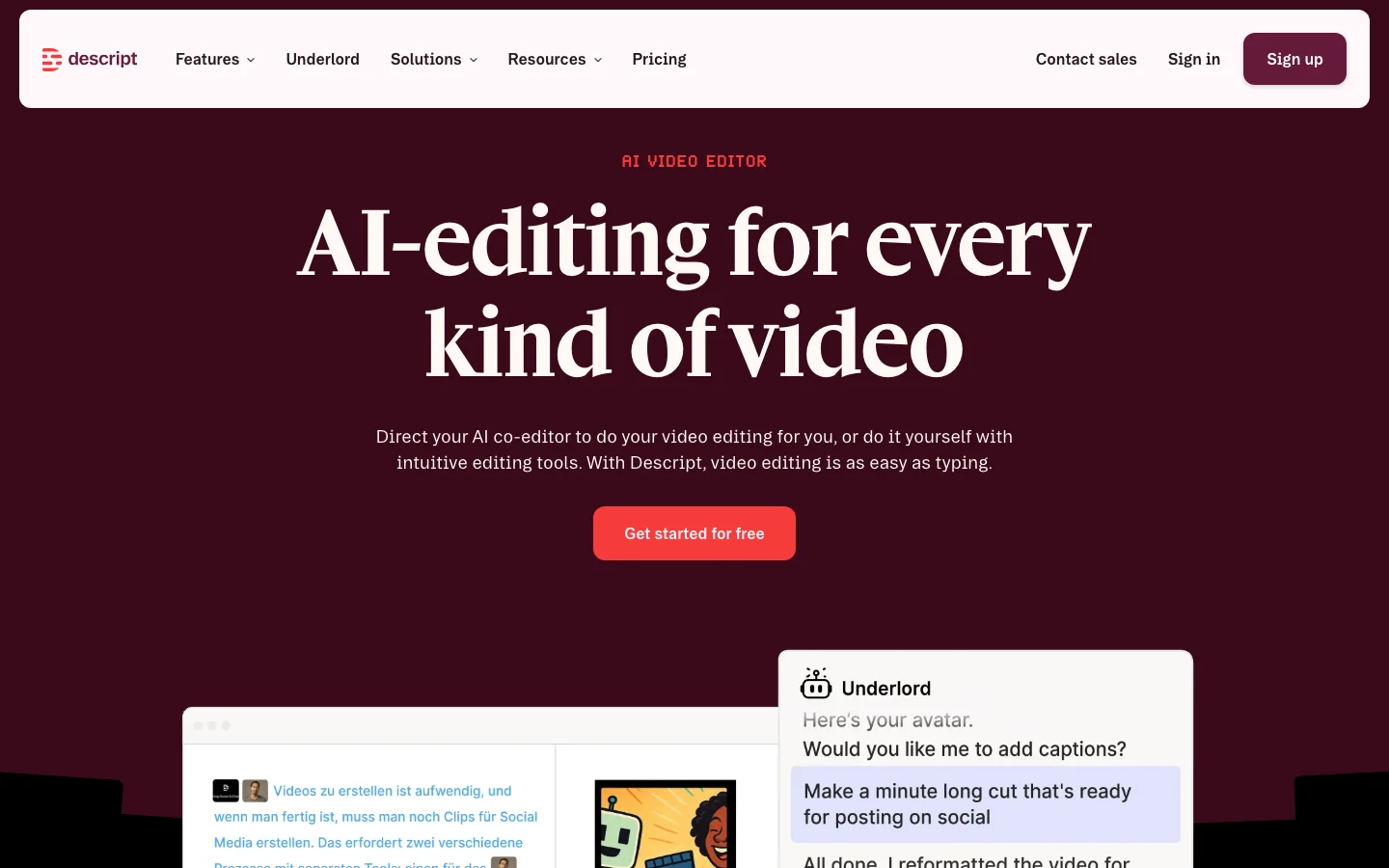

Descript is an AI-powered audio and video editor built around a simple idea: you edit media by editing the transcript. Instead of scrubbing through waveforms and timelines, you read the words, delete the ones you do not want, and the audio and video follow. After testing it across podcast editing and video content workflows, this core concept genuinely changes how you approach editing spoken content. For podcasters and video creators who work primarily with talking-head material, it removes most of the friction that makes traditional timeline-based editing slow. The feature set extends well beyond transcript editing. Overdub lets you clone your own voice with AI and fix audio mistakes without re-recording, a capability podcasters consistently cite as a primary reason they stay with Descript. Filler word removal ("um," "uh," "like") works with one click and is the single most praised feature across user reviews. Studio Sound handles noise removal and audio enhancement. Underlord, the AI assistant, automates tasks like creating highlight clips, writing show notes, and generating chapter markers. Descript Rooms, built on the SquadCast acquisition, handles remote guest recording. And an API now in early access opens automation through Zapier and Claude/MCP integration. Pricing restructured to a credit-based model in 2025 and the community reaction has been consistently negative. The free plan is too limited to finish a real project. Hobbyist starts at $16/month billed annually ($24 monthly), Creator at $24/month annually ($35 monthly), Business at $50/user/month annually ($65 monthly). Descript has no lifetime-deal option: every plan is a recurring subscription, billed monthly or annually. Credits get consumed by both successful and failed AI tasks, meaning Underlord can drain your budget on work it does not complete. One user reported a quote of over $1,200/month for heavy text-to-speech usage. For standard podcast editing the pricing is workable, but anyone relying heavily on AI features needs to track credit burn carefully. Descript pioneered transcript-based editing and that core innovation remains genuinely useful. The tool is best-in-class for the podcast and online course workflow it was designed for. Underlord is unreliable enough that users describe it bluntly in community threads, and the credit pricing has created real churn among long-term subscribers. Competitors including CapCut, Adobe Premiere with AI features, and Riverside.fm are absorbing some of that outflow. If you are evaluating AI video editing tools, compare Descript with Vozo AI for a different approach to AI-assisted editing, or explore ElevenLabs if voice generation quality is your primary concern. What Makes Descript Different Most video editors treat the timeline as the primary interface. You scrub through footage, find the section you want to cut, and mark in and out points. Descript inverts this: the transcript is the primary interface, and the timeline is secondary. You read the transcript like a document, select the words or sentences you want to remove, hit delete, and both the audio and video are cut. For anyone who edits spoken content, this is a fundamentally faster workflow. The practical impact is significant for podcasters and course creators. A 60-minute recording might generate 9,000 words of transcript. Finding a rambling section by skimming text takes seconds. Finding the same section by scrubbing a waveform takes minutes. Multiply that across every edit in a 60-minute episode and the time savings compound. This is why Descript retains loyal users even as they complain loudly about pricing: the editing paradigm is genuinely better for spoken content than anything else on the market. Beyond the transcript core, several features distinguish Descript from other AI video editors: Overdub (AI Voice Cloning): You train a voice model on 10 minutes of your own audio. After that, you can type corrections directly into the transcript and Overdub generates audio in your voice. No re-recording, no audio mismatches, no retakes. For podcasters who record alone and catch mistakes in post, this is genuinely useful. No close competitor offers this natively at the same quality level. Studio Sound: One-click noise removal and audio enhancement powered by AI. Upload a recording from a noisy home office and Studio Sound strips the background, normalizes levels, and improves clarity. The known limitation is that it adds subtle reverb artifacts when applied to very short sections, which some users find worse than the original problem. Eye Contact Correction: Available on Creator and above, this feature uses AI to adjust your gaze in recorded video so you appear to be looking at the camera even when reading notes or looking at a second screen. It is imperfect at extreme angles but works well for standard webcam recordings. Underlord AI Agent: Underlord is meant to automate the tedious parts of editing: removing filler words, shortening silences, generating highlight clips for social media, writing show notes, and building chapter markers. In practice it is less reliable than the marketing suggests. The community reaction is split: some users get consistent value from filler removal and silence shortening; others report Underlord failing tasks without warning and consuming credits for incomplete work. AI Speakers (Text-to-Speech): Descript offers a library of AI-generated voices for narration, voiceovers, and commentary. Useful for adding narration to screen recordings without recording audio yourself. The credit cost becomes a serious concern at production scale. Descript Rooms: Remote recording for podcast guests, built on the SquadCast infrastructure Descript acquired. Records each participant on separate tracks, at high quality, in-browser. The integration means you can go from remote recording to finished edit without leaving Descript. API Access: An API opened in early access in 2026 allows importing files, triggering Underlord workflows, and integrating with Zapier or Claude/MCP for automated production pipelines. The developer community has responded positively, though the API is early and feature coverage is limited. The result is a tool that covers the full podcast and online course production workflow: remote recording, transcription, editing, filler removal, noise cleanup, captions, social clips, and publishing, without switching between applications. For the right use case, replacing five separate tools with one is a meaningful operational simplification. Descript Pricing Plans 2026 Descript switched to a credit-based pricing model in 2025. Each AI action, including transcription, Overdub, Underlord tasks, and AI Speakers, consumes credits from your monthly allocation. The shift away from simple minute-based plans created significant frustration because credits are less predictable than minutes, and because failed Underlord tasks still consume credits even when they produce no usable output. Free Plan The free tier gives you access to Descript with very limited AI credits. It is realistic as a trial window to test the transcript editing interface, but there is not enough credit allocation to complete a full podcast episode or course module from recording to publish. If you want to genuinely evaluate Descript, you will need at least a Hobbyist subscription. Hobbyist: $16/month billed annually ($24 monthly) The entry paid tier. Includes transcript editing, basic Underlord access, captions, and screen recording. AI credit allocation is limited. Suitable for occasional content creators publishing one or two pieces per month who do not rely heavily on AI automation. Overdub voice cloning is not included at this tier. Creator: $24/month billed annually ($35 monthly) The tier where Descript becomes a serious production tool. Creator adds Overdub voice cloning, expanded Underlord credit allocation, AI clip generation, Eye Contact correction, and Green Screen background removal. This is the recommended tier for podcasters publishing weekly and YouTube creators with regular upload schedules. The $24/month price is comparable to a single Riverside.fm subscription, a single Otter.ai subscription, and a Canva Pro subscription combined, which gives context to the "all-in-one" value proposition. Business: $50/user/month billed annually ($65 monthly) Business adds a larger AI credit pool, team collaboration features, priority support, and API access. At $50/user/month billed annually ($65 monthly) it is meaningfully more expensive than Creator for solo operators. The tier makes sense for production agencies or marketing teams where multiple editors need access and the credit volume justifies the per-seat cost. If you are a solo podcaster or solo YouTuber, Creator is almost certainly enough. Enterprise: Custom pricing Enterprise provides volume credit allocations, SLA guarantees, dedicated onboarding, and compliance documentation. Aimed at media companies and large marketing operations with high-volume production requirements. Get a quote from Descript's sales team for specifics. What to Watch for with Credits The credit model has practical implications worth understanding before you subscribe. Underlord tasks that fail mid-process still consume credits. AI Speakers (text-to-speech) burns credits at a rate that becomes expensive for high-volume narration work: users with production-scale TTS workflows report quotes exceeding $1,200/month when using Descript for this purpose. If text-to-speech is central to your use case, evaluate Murf AI or ElevenLabs as dedicated alternatives with predictable pricing. For editing podcasts and videos where TTS is occasional, the Creator tier credit allocation is workable. Descript vs Traditional Video Editors The honest comparison between Descript and traditional NLEs (non-linear editors) is not "Descript is better." It is "Descript is better for specific workflows and worse for others." Descript vs Adobe Premiere Pro Premiere Pro is a professional production environment for highly produced video: multicam with complex color grading, visual effects, advanced audio mixing, and broadcast output. If your workflow involves multiple camera angles, motion graphics, significant color work, or cinematic production values, Premiere is the right tool and Descript is not a replacement. Where Descript wins is the editing speed for spoken content. A podcast episode that takes 90 minutes to rough cut in Premiere might take 30 minutes in Descript if the edit is primarily dialogue-based. Premiere has added AI features (auto-transcription, remix, enhance speech) but they are additions to a complex interface, not the primary interface. Descript vs Final Cut Pro Final Cut is Mac-only, one-time purchase ($299), and faster for timeline-heavy workflows on Apple hardware. Similar comparison to Premiere: better for visually complex production, slower for transcript-based dialogue editing. The one-time pricing is an advantage over Descript's subscription for low-volume creators. Descript vs CapCut CapCut is the strongest competitive threat to Descript in the short-form content space. CapCut is free for most features, mobile-native, has a large template library, and produces social-ready content quickly. For YouTube Shorts, TikTok, and Instagram Reels, CapCut is faster and cheaper. Descript is stronger for long-form content (full podcast episodes, 30+ minute YouTube videos, online courses) where transcript editing provides real advantage. If your primary output is short-form social content, CapCut is the more practical choice. For long-form spoken content, Descript wins. Descript vs Vozo AI For AI-first video editing within the Belreos catalog, Vozo AI takes a different approach, focusing on AI-generated video and short-form content rather than transcript-driven editing of recorded footage. They serve different primary use cases: Descript for editing real recordings, Vozo for generating and assembling AI-native video content. The bottom line: if your content is primarily dialogue-based (podcast episodes, online courses, talking-head YouTube videos, webinar recordings), Descript outperforms traditional NLEs on editing speed by a significant margin. If your content is visually complex or short-form social-first, the traditional tools or CapCut are likely better fits. Is Descript Worth It in 2026? It depends on which tier you are evaluating and how you use AI features. For podcasters publishing weekly, the Creator tier at $24/month delivers real value. Transcript editing is faster than waveform editing for dialogue. Filler word removal works consistently and is the feature users cite most often as genuinely useful. Overdub handles the "I need to re-record this sentence but I am already at the edit stage" problem that every podcaster eventually hits. If you publish one episode per week, the time savings over a year likely exceed the subscription cost by a meaningful margin. For online course creators, the value calculation is similar. Transcript editing, captions, and Overdub for correcting narration errors are genuinely useful. Eye Contact correction helps if you are reading from notes while recording. Studio Sound cleans up audio from home office environments. Where the value calculation gets complicated is with Underlord. If you are subscribing primarily for AI automation, specifically for automated social clip generation and AI-written show notes, the reality is more frustrating than the marketing. Underlord's clip generation still requires significant manual curation, and failed Underlord tasks consume credits. Several users report feeling the AI layer is "mostly useless" in its current state, with the transcript editing and Overdub carrying the actual value. The 2025 pricing restructure also shifted the value calculation for legacy users. Former plan holders who migrated reported paying roughly 26% more for equivalent access. That sting is real, and it explains the churn discussion in the community. For new subscribers evaluating Descript fresh, the Creator tier at $24/month is priced reasonably against the combination of tools it replaces. For users who joined at lower legacy rates, the comparison is less favorable. If Descript is on your shortlist, start with the free tier to confirm the transcript editing interface works for your content type, then trial Creator for one billing cycle before committing. The interface is either a revelation or a frustration depending on your workflow, and it is worth verifying before committing annually. Frequently Asked Questions Is Descript worth the Creator tier price? For podcasters and course creators publishing at least twice a month, yes. The $24/month Creator tier includes transcript editing, Overdub voice cloning, filler word removal, captions, and expanded Underlord credits. The combined time savings on a regular publishing schedule typically exceed the subscription cost. For occasional creators publishing once a month or less, the Hobbyist tier at $16/month billed annually ($24 monthly) or a free trial cycle is a better starting point. How does Descript pricing compare to CapCut? CapCut is free for most features, which makes it difficult to compare directly. CapCut wins on price for short-form social content where its template library and mobile workflow are strongest. Descript wins on editing speed for long-form spoken content where transcript editing provides advantage CapCut does not offer. If you are primarily making YouTube Shorts or TikToks, CapCut is the more cost-effective choice. If you are primarily editing full podcast episodes or online course modules, Descript's paid tiers are justified by the time savings. Does Descript work for long-form videos? Yes, transcript editing actually scales better with longer content than traditional timeline editing does. A 90-minute interview is faster to rough cut in Descript than in Premiere because you can read through the transcript and make selections in text rather than scrubbing 90 minutes of waveform. The known limitation for long-form content is that Underlord's automated clip generation for social media still requires substantial manual curation: the AI suggestions are a starting point, not a finished output. Plan for manual review of any AI-generated clips. What AI voices does Descript offer in 2026? Descript offers AI Speakers, a text-to-speech library of AI-generated voices for narration and voiceover work. The more distinctive feature is Overdub: you can create an AI model of your own voice by training on roughly 10 minutes of your existing recordings. Overdub lets you type transcript corrections that are then synthesized in your voice, useful for fixing errors in recorded audio without re-recording. For broader AI voice generation needs, dedicated tools like ElevenLabs offer more voice variety and higher output quality, though Overdub's personal voice cloning remains a unique offering for the editing use case. Can I export broadcast-quality video from Descript? Descript exports standard video formats at resolutions up to 4K on paid tiers. For podcast video content (talking head, screen recordings, multi-track remote interviews), the export quality is suitable for YouTube and social platforms. Where Descript is not a replacement for Premiere or Final Cut is in the post-production layer: color grading, visual effects, complex audio mixing, and broadcast master file delivery. If your output requires those capabilities, Descript fits earlier in the workflow (recording, transcript editing, rough cut) and you hand off to a traditional NLE for finishing. Does Descript replace traditional video editors? For podcast and online course workflows, it replaces most of what creators actually do in traditional NLEs: rough cutting, filler removal, silence shortening, caption generation, and basic audio cleanup. For cinematic video production requiring color grading, visual effects, advanced audio design, or broadcast output specifications, it does not. Many professional video creators use Descript for the transcript-based rough cut stage and finish in Premiere or Final Cut for color and audio polish. The two tools serve different parts of the production workflow rather than being direct replacements.
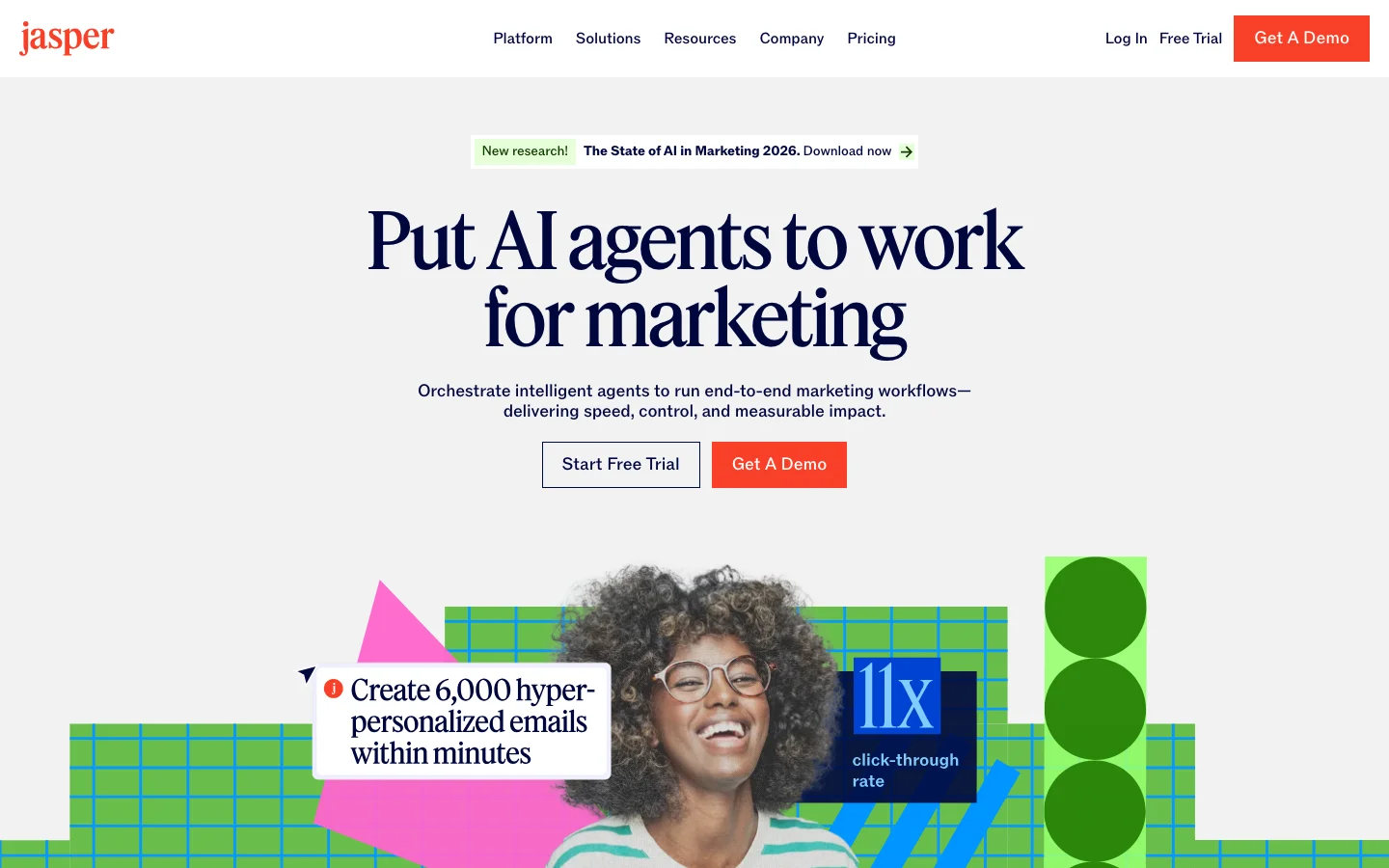
Jasper AI is the premium AI platform built for marketing teams. Its 2026 positioning has shifted substantially: Jasper no longer describes itself as an AI writing tool. The current headline is "AI agents for marketing," with Brand Voice, governance controls, and campaign workflow automation as the primary selling points. If you are evaluating it as a writing assistant, you are looking at a product that has moved past that framing entirely. We tested it across a three-person content team for two weeks. The verdict is unchanged from prior assessments but with important updates on pricing and new features: if you have a real brand voice and a content operation to maintain across multiple writers, Jasper earns its price. If you are a solo writer or a small team comparing it to ChatGPT Plus at $20/month, the case is much harder to make at $69/seat/month. The Brand Voice feature remains the core differentiator. Train it on your existing landing pages, past articles, and email sequences and every output applies your company tone and vocabulary without starting from scratch each session. We ran the same brief through Jasper and through raw GPT-4. Jasper's output sounded like us. GPT-4's output sounded like the internet. For a team where multiple writers need to produce on-brand copy at volume, that consistency has real dollar value. The 2026 additions layer agents and governance controls on top of that foundation. What Makes Jasper Different in 2026 The 2026 Jasper product is built around three interconnected layers: Jasper IQ, Canvas, and Agents. Jasper IQ is the knowledge and governance layer. It stores your Brand Voice (trained on your content), Visual Guidelines, Style Guide, a Knowledge base of company and product facts, and Audience definitions. Every generation pulls from these assets automatically. This is what separates Jasper from raw GPT-4: you are not re-explaining your brand in every prompt. The system already knows it. Pro plan users get 2 Brand Voices, 5 Knowledge assets, and 3 Audience definitions. Business plan users get unlimited. Canvas is the writing workspace, rebuilt as a structured content creation environment rather than a simple editor. It integrates with HubSpot and Google Docs so teams can write and publish without leaving their existing workflow. The Surfer SEO integration for real-time content scoring inside the editor is still present on integrated plans. Agents are the major 2026 addition. Pro plan includes Essential Agents for core marketing workflows: research, optimization, personalization at the task level. Business plan adds Advanced Agents for complex campaign orchestration, a no-code AI App Builder for creating custom agents without developers, and Jasper Grid for scaled systematic content execution. Jasper Grid lets you run one brief into 50 variations simultaneously, which is the kind of feature that changes how performance marketing teams operate at scale. Jasper also launched a Brand Compliance Diagnostic in 2026, a free tool that scans your website and public content to score how consistently you present brand governance. It is a lead generator for Jasper's IQ governance pitch, but it is genuinely useful as a standalone diagnostic. Jasper Art is still available but has been deemphasized significantly. It is no longer a primary selling point in the 2026 product lineup. If AI image generation is a core need, dedicated tools outperform what Jasper offers here. Jasper AI Pricing Plans 2026 Jasper restructured its pricing for 2026. The old Creator and Teams tiers at $39-$125/month are gone. Current pricing is per-seat: Pro : $69/seat/month (monthly) or $59/seat/month (annual): Includes 1 seat, Canvas workspace, Essential Agents for core marketing workflows, 2 Brand Voices, 5 Knowledge assets, 3 Audience definitions. 7-day free trial available. This is the practical entry point for marketing teams and individual power users who need brand consistency. Business : Custom pricing (contact sales): Everything in Pro, plus Advanced Agents for complex campaign orchestration, the no-code AI App Builder for custom agent creation, Jasper Grid for scaled content execution, unlimited Brand Voices, Knowledge assets, and Audiences, API access, MCP integration, enterprise governance with admin controls and groups, dedicated account management, and priority support. Required for teams running multi-channel campaigns at scale. There is no free tier. The 7-day Pro trial requires a credit card. For teams that need to evaluate Jasper properly before committing, the trial period is short relative to the setup time required for Brand Voice and Knowledge base configuration. Budget time for onboarding before you can fairly assess the output quality. At $69/seat, a three-person content team pays $207/month. Compared to ChatGPT Plus at $20/person ($60/month for three), the Jasper premium is $147/month. That premium is justified if Brand Voice consistency, workflow integration with HubSpot or Surfer, and Agent automation save meaningful editing time or reduce brand review cycles. It is not justified for teams that primarily need a capable writing model without the workflow layer. Jasper AI Pricing 2026: Complete Plan Breakdown Jasper currently offers two plans: Pro at $69/month and Business at custom pricing. There is no free plan, no Creator plan, and no entry-level tier below $69/month. The 7-day trial requires a credit card and auto-converts if you do not cancel before day 7. Plan Monthly price Annual price (per month) Seats Brand Voices Key limits Pro $69/mo $59/mo 1 2 5 multi-modal Knowledge assets, Canvas workspace, Essential Agents Business Custom (contact sales) Custom, 12-month minimum Unlimited Unlimited Advanced Agents, AI App Builder, Jasper Grid, API, MCP, SSO, SCIM, dedicated account manager Annual billing on Pro saves $10/month ($59 vs $69). Business requires a 12-month minimum commitment with no monthly option. Both tiers are marketed as unlimited words. What happened to the cheaper Jasper plans? Jasper's entry-level options have been stripped back in stages. The $29/month Starter plan was discontinued first. The $49/month Creator plan was listed on earlier pricing pages and is no longer shown on jasper.ai/pricing as of mid-2026. As of today, the lowest price you can pay for Jasper is Pro at $69/month ($59/month on annual billing). That is a significant shift for users who were paying $29 or $49. This is almost certainly driving the +1950% spike in searches for "jasper ai price." Former Starter and Creator users are re-checking what Jasper costs now and finding the floor has more than doubled from what they were paying. If you are one of those users, the short answer is: there is no path back to a cheaper Jasper plan. Pro at $69/month is the entry point. What happened to Boss Mode? Boss Mode was replaced by the Pro plan. If you are searching for Boss Mode pricing, Pro at $69/month monthly or $59/month annual is the current equivalent. The feature set has expanded since Boss Mode (Agents, Knowledge base, Canvas workspace), but the price has risen from old Boss Mode rates. The Surfer SEO hidden cost Surfer SEO integration requires a separate Surfer subscription. Surfer starts at $99/month. The real all-in cost for a content SEO workflow on Jasper Pro is approximately $168/month ($69 Jasper + $99 Surfer). Jasper's pricing page does not surface this additional cost. If SEO content is the primary reason you are considering Jasper, budget $168/month rather than $69, and compare that total against alternatives where SEO tooling is bundled. The seat wall Pro is a single-seat plan. Adding a second user requires Business, which is custom-priced with a 12-month minimum commitment. Procurement data suggests Business typically starts around $500+/month for small teams. There is no published 2-3 seat middle tier. Freelancers managing multiple client brands hit the 2 Brand Voice cap on Pro and have no upgrade path short of Business pricing. Is the 7-day trial actually free? The trial gives full Pro plan access. A credit card is required at signup, and the account auto-converts to a paid subscription at the end of day 7. Multiple Trustpilot reviews flag unexpected charges from users who believed they had cancelled. Jasper's stated policy: no refund unless you email them within 7 days of the charge. Set a calendar reminder for day 5 or 6, not day 7. Cancel through the account settings, not by stopping use of the tool. Jasper AI vs Alternatives The competitive positioning has clarified in 2026. Writesonic pivoted toward GEO and AI search tracking, competing on different ground. Copy.ai went B2B sales automation. That leaves Jasper as the primary dedicated AI writing and marketing workflow platform for content teams, which is both its strength and its risk. The pressure from below is real: ChatGPT Plus pulls away solo writers who do not need the workflow layer. For teams already using HubSpot, Jasper's native CRM integration is the strongest workflow argument. Write and publish without leaving your CRM. For teams using Surfer SEO, the in-editor scoring eliminates the tab-switching that fragments writing sessions. Neither integration is available in ChatGPT or Claude directly. For GEO and AI search visibility tracking, Jasper does not compete. That is Writesonic's territory. Jasper added SEO, AEO, and GEO as solution categories in 2026, but the actual tracking infrastructure is not yet comparable to dedicated GEO tools. Browse the full AI writing tools category for a side-by-side comparison, or see how it stacks up against Copy.ai for content automation use cases. Is Jasper AI Worth It in 2026? For marketing teams with real brand governance needs and HubSpot or Surfer SEO already in the stack, yes. For solo writers or small teams without those integration requirements, the math is hard to justify at $69/month when ChatGPT Plus and Claude Pro are $20/month and cover the raw writing use case. Worth it if: you run a content team where multiple writers need to produce in the same brand voice, you are already using Surfer SEO and HubSpot, or you need Agent-driven campaign automation. The Brand Voice and Knowledge base layer has real ROI for teams doing high-volume on-brand content production. Not worth it if: you are a solo writer or freelancer, you are comparing it to ChatGPT Plus at $20/month (Jasper costs 3.5x more and the raw writing quality advantage is marginal), or you need more than one seat without Business pricing. The discontinued $29 Starter and the no-longer-listed $49 Creator were the value-for-money entry points; with both gone from the pricing page, the solo-user case for Jasper is weak. Pro is one seat at $69/month. For a writing team that needs two or three people in the same tool, the next step is Business at custom pricing with a 12-month minimum. That jump is steep, and it is the most common reason teams re-evaluate Jasper at budget time. Jasper AI Pricing FAQ How much does Jasper AI cost per month? Jasper Pro costs $69/month on monthly billing or $59/month on annual billing. Business is custom pricing. There is no free plan and no lower-priced tier below Pro. Does Jasper AI have a free plan? No. There is a 7-day trial on Pro that requires a credit card. It auto-converts to a paid subscription if not cancelled before day 7. There is no permanent free tier. What happened to the Jasper AI Starter and Creator plans? The $29/month Starter plan was removed. The $49/month Creator plan is no longer shown on jasper.ai/pricing as of mid-2026. Pro at $69/month is now the cheapest way into Jasper. If you were on one of those plans and are re-checking pricing, there is no equivalent lower-cost option currently available. What happened to Jasper Boss Mode? Boss Mode was replaced by the Pro plan. The current equivalent is Pro at $69/month monthly or $59/month annual, with expanded features including Agents, the Knowledge base layer, and Canvas workspace. Does Jasper AI include Surfer SEO? The Pro plan includes a Surfer SEO integration, but Surfer SEO is a separate paid product. You need your own Surfer subscription (starting at $99/month) to use the integration. The all-in cost for an SEO content workflow on Jasper Pro is approximately $168/month.
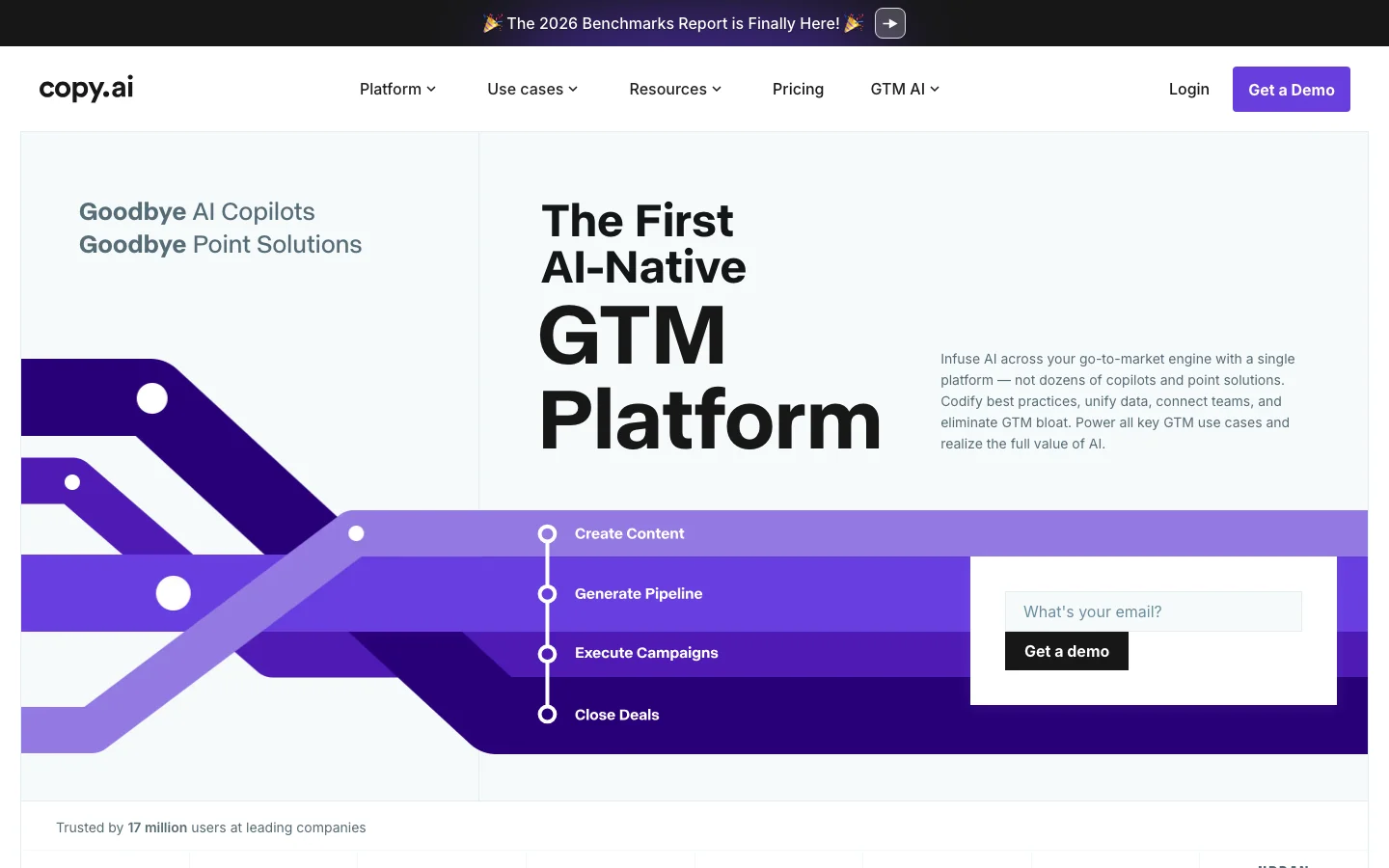

Copy.ai started as an AI copywriting tool and pivoted hard into B2B GTM automation, and that pivot is the entire lens through which this tool makes sense. We tested it as a writing tool and as a sales workflow platform, and the conclusions are completely different depending on which hat you are wearing. As a writing tool, Copy.ai is not competitive. We ran the same briefs through Copy.ai and through Jasper and the quality gap was visible in the first paragraph. The community consensus in every thread we read is identical: ChatGPT Plus at $20/month beats Copy.ai for general writing at a fraction of the cost. If you found Copy.ai through a writing tool comparison and are considering it for blog posts or brand content, stop here and look elsewhere. The product is no longer built for you. As a B2B GTM platform, the story changes. The GTM Workflows product chains prospect research, outreach drafting, personalization, and CRM push into automated sequences that actually reduce SDR research time. The Perplexity integration brings real-time web intelligence into the generation layer. Sales reps can generate prospect-aware outreach informed by current news without leaving the platform. The Salesforce and HubSpot connections mean sequences get pushed without manual handoffs. In the gap between raw Writesonic-style AI writing and full enterprise sales platforms like Outreach or Salesloft, Copy.ai fills a real space for SMB B2B teams running outbound at volume. See our AI writing tools comparison for a full breakdown of where Copy.ai fits versus Jasper and Writesonic. The friction is real too. The free trial burns through credits before you can properly evaluate the GTM features that justify the purchase, a frustrating onboarding experience that pushes users away before they reach the value. Brand voice capability is weaker than Jasper's trained system. And the GTM pivot creates genuine positioning confusion: a lot of people buy the wrong thing and leave disappointed. Copy.ai has consolidated to a single self-serve plan, Chat at $29/month for 5 seats; Enterprise is available at custom pricing for larger teams. Browse the full AI writing tools category if you are still evaluating alternatives. Verify current pricing at copy.ai. Frequently Asked Questions Is Copy.ai legit and safe to use? Copy.ai is a legitimate, funded AI software company operating since 2020 with a documented enterprise customer base. The platform handles your content data under standard SaaS privacy terms; enterprise plans include additional data governance controls. It is a real product with real customers. The credibility question is less about legitimacy and more about fit: Copy.ai has pivoted hard toward B2B GTM automation, and buyers expecting a general-purpose writing tool often feel misled by the positioning. How much does Copy.ai cost in 2026? Copy.ai has consolidated to a single self-serve plan: Chat at $29 per month for 5 seats, placing it below Jasper's entry pricing. Enterprise is available at custom pricing for larger teams needing guided implementation. There is no free plan on the current self-serve pricing page; a separate "Free Tools" section offers one-off templates, not a subscription tier. Verify pricing at copy.ai. Is Copy.ai worth the subscription? For B2B sales teams running CRM-integrated outbound sequences, Copy.ai delivers real time savings that justify the cost: the GTM Workflows chain prospect research, drafting, and CRM push into automated sequences that would otherwise require manual steps across multiple tools. For general writing (blog posts, articles, marketing copy), the community consensus is clear: ChatGPT Plus at $20 per month outperforms Copy.ai at a fraction of the cost. Know which buyer you are before subscribing. Does Copy.ai have a free trial or free plan? No, Copy.ai does not currently offer a free plan on its self-serve pricing page. A separate "Free Tools" section offers one-off templates and basic AI writing without a subscription, but excludes the GTM Workflow automation features that define the paid tier. Evaluating the GTM capabilities, the main reason to consider Copy.ai over cheaper alternatives, requires the paid Chat plan at $29/month.