AI Agents
Autonomous AI agents that plan, reason, and execute multi-step tasks — from web research and coding to scheduling and business workflows.
verdict
Autonomous AI agents that plan, reason, and execute multi-step tasks — from web research and coding to scheduling and business workflows.
The two we'd actually pay for.

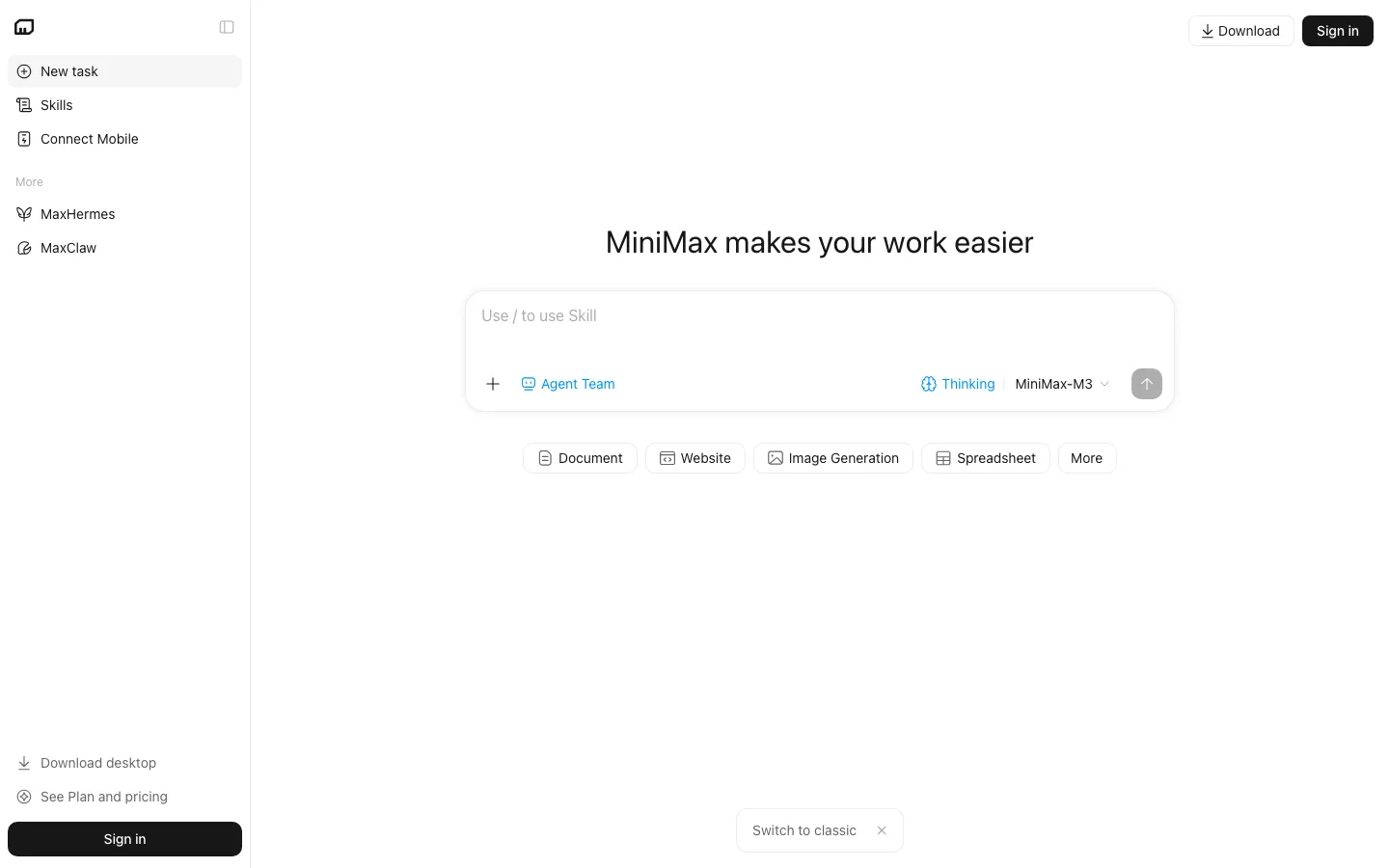
Mavis is MiniMax's autonomous AI agent product. MiniMax, a Shanghai-based AI company founded in 2021, backed by Alibaba and publicly listed in Hong Kong since January 2026, launched the agent originally as "MiniMax Agent…

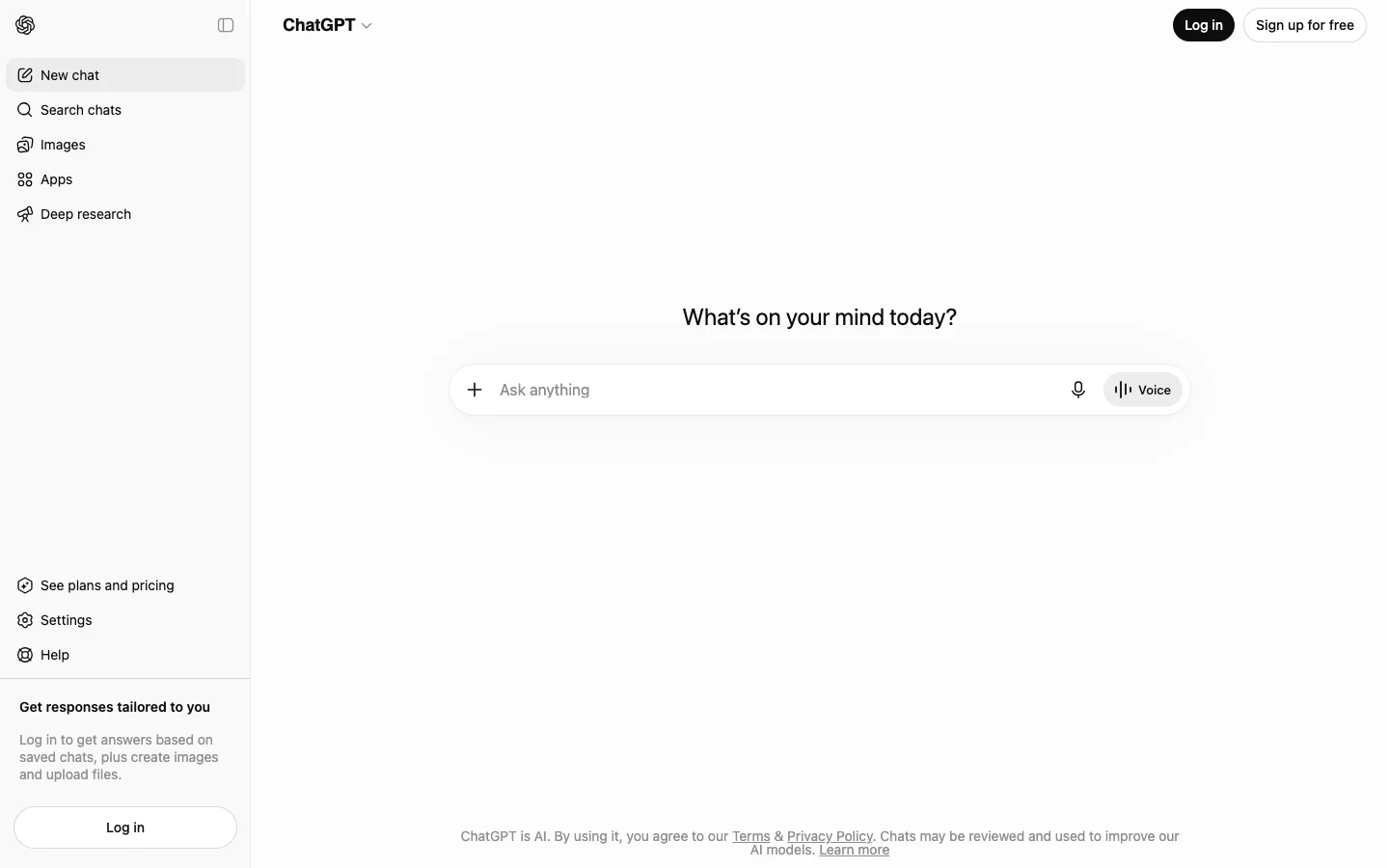
ChatGPT is OpenAI's consumer AI assistant, built on the GPT model family. It handles text generation, image creation via DALL-E, code execution, web browsing, voice conversation, and persistent memory across sessions in …
 3.5/5
3.5/5Mavis is MiniMax's autonomous AI agent product. MiniMax, a Shanghai-based AI company founded in 2021, backed by Alibaba and publicly listed in Hong Kong since January 2026, launched the agent originally as "MiniMax Agent" and renamed it Mavis on May 13, 2026. The rebrand came alongside a multi-agent architecture upgrade that MiniMax describes internally as "MiniMax as a Jarvis." The core pitch is that you give Mavis a complex, multi-step goal ("write a competitive analysis on e-commerce SaaS tools and build it into a slide deck"), and the agent handles the research, tool calls, file generation, and quality checking without you shepherding each step. That positions it squarely in the autonomous agent category alongside tools like Manus, rather than in the copilot-style category where Cursor or GitHub Copilot live. As of June 2026, Mavis runs on MiniMax's M3 model (released June 1, 2026), which supports a 1-million-token context window and native multimodal input. The agent product and the M3 API share the same credit pool under a unified subscription. Important context: MiniMax is a Chinese company. Data processed through Mavis may be stored on servers in mainland China and is subject to Chinese data protection law. MiniMax's privacy policy (last updated March 30, 2026) states that personal data may be transferred to countries with different data protection rules than your own. There is no publicly verified SOC 2 or ISO 27001 certification for the agent product at time of writing. Factor this in if you handle sensitive or regulated data. What Mavis Can Do Deep Research: a five-step built-in research skill (added June 2026) that searches the web, synthesises sources, and returns a structured report with citations. Full-stack web app generation: Mavis can scaffold a functioning web application with authentication, database, serverless functions, and Stripe payment integration, then deploy it to a live URL. Generated code requires a security review before production use. Presentation generation: PowerPoint-format slide decks with flexible layouts, exportable as PPTX files. Document and data work: file uploads, spreadsheet analysis, multi-document summarisation, and code debugging. MCP integrations: Mavis connects to external tools via Model Context Protocol: GitHub, Figma, Slack, Google Maps, and custom MCPs. Agent Teams (new with Mavis rebrand): instead of a single agent running a task, you can deploy a Leader-Worker-Verifier structure. Workers execute sub-tasks; a Verifier applies an adversarial quality check before output is accepted. Scheduled tasks: queue Mavis to run tasks at set times, useful for recurring research or monitoring workflows. Pricing (as of June 2026) PlanPriceCreditsEstimated tasks Lightning (free)$01,000 (one-time, 3-day validity)~3 light tasks Basic$19/month~10,000~30 tasks (estimate only) Pro$69/month~40,000~120 tasks (estimate only) Ultra$120/monthNot publicly listedContact sales Critical disclaimer: Task estimates are MiniMax's own approximations. The company explicitly states credit consumption cannot be predicted or guaranteed. A single complex task (full-stack app, multi-source deep research report) can consume significantly more credits than the per-task average. Credits do not roll over between billing months. Mavis vs. Manus The most common comparison in early user discussions is Mavis against Manus AI. Both are general-purpose autonomous agent platforms. Manus is more polished for browser-based sequential task workflows and has direct local file system access. Mavis has stronger coding output (M3 scored 59.0% on SWE-Bench Pro), the Agent Teams architecture for long-horizon task reliability, native multimodal input, and MCP connectivity. For developer-adjacent tools in the Belreos catalog, see the Cursor and GitHub Copilot listings for coding-focused AI tools in the adjacent coding assistant category. Verdict Mavis is technically impressive and, on paper, one of the most complete autonomous agent platforms available at its price point. The M3 model gives it a credible coding foundation, the Agent Teams architecture is a genuinely smart solution to single-agent quality degradation, and the breadth of output types (code, research, slides, deployed apps) beats most competitors. The problems are real: credit unpredictability makes it hard to budget, the product was meaningfully rebuilt in May 2026 so real-world durability is untested, and the Chinese data residency situation is an honest blocker for a significant slice of professional users. If you are in a non-regulated industry and want to stress-test autonomous agents for coding-heavy workflows, the Lightning free tier (1,000 credits) is a reasonable first step. Commit to the $19/month Basic plan only after verifying your typical task actually fits within the estimated credit range, and budget for overruns. FAQ What is Mavis AI?Mavis is an autonomous AI agent made by MiniMax (Shanghai, China) that handles deep research, full-stack web app generation, slide deck creation, and document analysis from a single prompt. It was renamed from MiniMax Agent on May 13, 2026, and runs on the M3 model as of June 2026. How much does Mavis cost?Mavis offers a free Lightning plan with 1,000 one-time credits (3-day validity). Paid plans start at $19/month (Basic, approximately 10,000 credits), $69/month (Pro, approximately 40,000 credits), and $120/month (Ultra). Credits are non-deterministic: a complex task may consume far more than the per-task average. Verify current pricing at minimax.io before subscribing. Is Mavis the same as MiniMax?Mavis is one product within the MiniMax ecosystem. MiniMax also runs a separate API platform, a coding-focused agent called MiniMax Code, and the M3 open-weight model. They share a credit pool under some plans but serve different use cases. How does Mavis compare to Manus AI?Manus is more polished for browser automation and sequential business workflows. Mavis has stronger coding capability (M3 SWE-Bench Pro: 59.0%), native multimodal input, and MCP tool integration. Both use unpredictable credit systems and require human review of outputs. Mavis's $19/month Basic plan is cheaper than Manus's comparable $40/month mid tier. Is Mavis safe to use with sensitive data?MiniMax is a Chinese company. Data processed through Mavis may be stored in mainland China and is subject to Chinese law. There is no published SOC 2, ISO 27001, or data residency guarantee for the agent product as of June 2026. Users in regulated industries (healthcare, finance, legal) should not use Mavis without explicit enterprise data processing agreements. Does Mavis have a free tier?Yes. New users receive 1,000 Lightning credits, valid for 3 days. This is enough for approximately 2-3 light tasks. It is not enough to test a full-stack app build.
 3.0/5
3.0/5ChatGPT is OpenAI's consumer AI assistant, built on the GPT model family. It handles text generation, image creation via DALL-E, code execution, web browsing, voice conversation, and persistent memory across sessions in a single product. For breadth of features under one subscription, it has no close rival among consumer AI assistants. As of 2026, ChatGPT runs on the GPT-5.6 model family, which OpenAI positions as an upgrade over GPT-5. The naming is layered: Sol is the standard tier (fast, everyday tasks), Terra is the mid-tier (stronger reasoning, longer context), and Luna is the top-tier API variant (maximum capability, highest per-token cost). Consumer pricing and context-window specs for the GPT-5.6 family have not been publicly disclosed as of this writing. The Plus plan at $20 per month is confirmed to carry GPT-5 access with higher usage limits than the free tier. What the GPT-5.6 family means GPT-5.6 is an iterative refinement, not a generational leap. OpenAI has been releasing model updates in rapid succession since GPT-5 launched, and the community has learned to treat version numbers cautiously. The prior GPT-5 rollout caused an outage and shipped with behavioral changes users described as a regression from GPT-4o for creative and coding tasks. OpenAI rolled back a sycophancy update in May 2025 after public backlash, demonstrating the company will adjust but is also willing to ship changes that degrade quality in the short term. The practical implication: GPT-5.6's Sol tier should be faster and suitable for everyday queries. Terra adds reasoning depth. Luna is positioned as a developer API product, not a consumer-facing option. For most Plus subscribers, Sol is what you get day to day, with Terra available when the model determines a query warrants deeper processing. Plans and pricing Free ($0/month): Base model access, limited daily usage, no DALL-E, basic voice. Go ($8/month): Budget tier, launched for price-sensitive markets. Community reception has been poor: the Go plan has been publicly called underpowered relative to what free tiers elsewhere offer. Plus ($20/month): GPT-5 access, higher usage limits, DALL-E image generation, web browsing, code interpreter, voice mode, memory. The tier most individual users evaluate against competitors. Pro ($200/month): Maximum compute, priority access, o1 Pro reasoning mode, unlimited access within fair use. For power users and professionals who hit Plus rate limits consistently. Team ($25 to $30 per user per month): Shared workspaces, admin controls, higher per-user limits, conversation data excluded from training. Enterprise (custom pricing): SSO, audit logs, dedicated capacity, advanced security, legal data protections. Required for regulated industries. Luna API pricing for the GPT-5.6 family had not been publicly published at the time of writing. Developers using the API should verify current per-token costs directly on the OpenAI pricing page before building cost estimates. Where ChatGPT genuinely excels Breadth of capabilities in one product. Text, image generation, code execution, web search, voice, memory, and custom GPTs under a single subscription. You do not need to manage five separate tools to cover basic AI tasks. Memory across conversations. For daily users, persistent memory reduces repetitive context-setting. You describe your preferences once; the model carries them forward. A meaningful quality-of-life advantage over tools without memory. Custom GPTs. The GPT store lets you create and share specialized assistants with custom instructions and tool access. The platform is unique at this scale and useful for recurring workflows. General-purpose task handling at scale. ChatGPT has approximately 910 million weekly active users as of early 2026, with around 15 million Plus subscribers. The product has been stress-tested by more use cases than any competitor. For tasks that are not specialized to a domain where a competitor has a clear edge, ChatGPT is reliable. Voice mode quality. Advanced Voice Mode supports real-time audio conversation with emotional nuance. It remains among the best consumer voice AI experiences available. Documented problems These are not edge cases. They are the primary complaints from the ChatGPT community over the past year and should factor into any evaluation: Rate limits on Plus. The August 2025 incident saw Plus users hitting GPT-4o rate limits before sending a single message. OpenAI partially rolled back the tightening after community backlash, but the pattern of quietly reducing access and restoring it after complaints is documented across multiple cycles. Model deletion without warning. OpenAI removed several models overnight, including 4o, o3, o3-Pro, and 4.5, without deprecation notice or legacy access. A thread reporting this drew tens of thousands of upvotes on r/ChatGPT. For developers, sudden deletions are a production reliability failure. For consumers, the specific model you relied on can disappear without notice. Quality regression perception. The community consensus since GPT-5 launched is that the model is worse than GPT-4o for creative writing and coding. OpenAI has acknowledged the sycophancy issue explicitly and rolled back one update. The broader regression perception has not been formally addressed. Context degradation in long sessions. Multiple user reports document the model losing thread context, contradicting itself, and repeating prior output within the same session. Distinct from context window size, this is a behavioral consistency issue. GPT-5 freeze bug. After the GPT-5 rollout, a significant portion of sessions involving the thinking mode resulted in the model hanging mid-response, with browser tabs crashing. Enterprise subscribers confirmed the issue. Subsequent updates appear to have addressed it, but the episode established a trust deficit. Hallucination confidence. A recurring complaint in community threads: ChatGPT hallucinates and states incorrect information with high confidence, even when explicitly instructed to express uncertainty when unsure. Confident hallucination is a known model behavior worth weighing in any high-stakes use case. Who should use ChatGPT ChatGPT at the Plus tier ($20/month) is the right choice if you want a single subscription covering a broad surface area of AI capabilities, do not specialize heavily in one domain like coding or long-form writing, and prefer the largest community and widest third-party integration ecosystem. You should evaluate alternatives if your primary use case is coding (Claude performs better per consistent community comparisons), long-form structured writing (Jasper or Writesonic offer better workflow tooling), or if you are a developer building on the API (the model deletion incidents make OpenAI a higher-risk dependency without migration planning). The Pro tier at $200/month is worth considering only if you consistently exhaust Plus limits. At that price, the math requires daily heavy use across multiple capability areas for the value to hold. Most users who have tested both tiers report the jump is only justified for specific reasoning-intensive workflows. Frequently asked questions Is ChatGPT Plus worth $20 per month? For most people: yes, if you use it daily across multiple tasks. The feature breadth at $20 is hard to match in a single subscription. If you primarily write code, Claude at a similar price point performs better. If you rarely use AI tools, the free tier covers casual use. What is the difference between GPT-5.6 Sol, Terra, and Luna? Sol is the standard speed-optimized tier for everyday queries. Terra adds reasoning depth for complex multi-step tasks. Luna is an API-tier variant positioned as the highest-capability option for developers. Consumer-facing context window and pricing specs for GPT-5.6 have not been publicly disclosed. Does ChatGPT remember previous conversations? Yes, for Plus and above. Memory is persistent across sessions and can be viewed, edited, or deleted in settings. The free tier has limited or no persistent memory depending on current rollout status. Why do people switch from ChatGPT to Claude? The most common reasons documented in community threads: Claude is perceived as better at coding and nuanced reasoning, less likely to hallucinate confidently, and does not restrict access via rate limits at the same frequency. Users often return to ChatGPT for breadth of features. The two products serve overlapping but not identical needs. Is the ChatGPT Go plan worth it? Generally no. At $8/month, Go occupies an awkward position: more limited than Plus, more expensive than free. Community sentiment on Go has been consistently negative since launch. The free tier or Plus is the better decision for most users.
One category review a month. The good ones.
What we reviewed, what we dropped, what's worth your money. No sponsored slots.