You set up a chatbot on your website. It takes fifteen minutes. You feel like a genius. Two weeks later, it tells a customer your waterproof jacket is "possibly water-resistant." That actually happened - a DTC brand owner documented it on Reddit after testing six chatbot platforms head-to-head.
That story is the backdrop for this entire guide. The AI chatbot builder market in 2026 is crowded, noisy, and full of products that demo well but fall apart under real customer traffic. We tested and researched seven of the most-discussed platforms, pulled actual user feedback from Reddit and review sites, and wrote down what we found - including the parts that vendors leave out of their landing pages.
If you're looking for the best AI chatbot for your website, this is the honest version.
The Market in 2026: Three Tiers
Before we compare individual tools, it helps to understand what you're actually choosing between. The AI chatbot market has split into three distinct tiers:
Tier 1: No-code FAQ bots. Upload your documents, get a widget. Chatbase, Dante AI, and CustomGPT live here. Setup is fast. The ceiling is low. These tools are commoditizing quickly.
Tier 2: Hybrid AI + live chat. AI handles the volume, humans handle the edge cases. Tidio and Droxy AI sit in this tier. This is the sweet spot for most small businesses in 2026.
Tier 3: Enterprise AI customer service. Per-seat pricing, per-resolution fees, full CRM integration. Intercom Fin is the representative here. Different budget class entirely.
There's also a developer/builder tier - Botpress - for teams that want logic control over no-code convenience.
The clearest signal from real-world user feedback over the past year: buyers are rejecting the "upload docs and pray" tier for anything beyond simple FAQ deflection. The hallucination problem is real and documented. We'll get into that.
Quick Comparison
| Tool | Best For | Starting Price | Pricing Model | Hallucination Controls |
|---|---|---|---|---|
| Chatbase | First chatbot, live today | ~$40/mo | Credit-based | None (upload and hope) |
| Droxy AI | Multi-channel SMBs (phone + web + social) | $16/mo | Flat monthly | None documented |
| Tidio (Lyro) | Ecommerce with live chat | Free / $29/mo | Per-conversation AI add-on | Human handoff built in |
| Intercom Fin | Growing support teams (5+ agents) | $29/seat/mo + $0.99/resolution | Per-seat + per-resolution | Knowledge base sourcing |
| Botpress | Developers needing custom logic | Free / $79/mo | Usage-based AI credits | Flow logic, conditional branching |
| CustomGPT | B2B with compliance requirements | ~$89/mo | Flat monthly | Citation transparency |
| Dante AI | Chatbase alternative | ~$12-19/mo | Flat monthly | None (upload and hope) |
1. Chatbase - The Default Starting Point
Category: No-code FAQ bot Price: Free tier available ($0/mo, 50 message credits, limited). Hobby ~$40/mo, Standard ~$150/mo, Pro ~$500/mo, Enterprise custom. Read the full review: /tools/chatbase
Most people considering a website chatbot encounter Chatbase first. It has the strongest SEO presence in the category and the fastest no-code setup - you can have a working chatbot live in fifteen minutes by uploading your documents and dropping a widget on your site.
That speed is real and valuable. So is the founder's track record - a verified $0 to $250K MRR bootstrap success story that the Reddit community acknowledged as credible.
The problems start at scale. Chatbase runs on a credit system where GPT-4o class responses consume significantly more credits than GPT-3.5 responses. On the Pro plan at $400/month, you get 40,000 credits - but at roughly 20 credits per GPT-4o response, that's effectively 2,000 responses per month. Multiple users report burning through credits at $0.20-0.25 per response.
"Been fighting with Chatbase for a couple months... the credit system is a nightmare - GPT-4o eats 20 credits per response." - r/nocode
The deeper issue is accuracy. In a widely-discussed DTC brand chatbot test on Reddit (102 upvotes, cross-posted to three subreddits), the tester grouped Chatbase with CustomGPT and Dante AI as "the ChatGPT Wrapper Tier":
"Literally just upload docs and pray. Mine kept hallucinating product specs. Told a customer our waterproof jacket was 'possibly water-resistant.' Can't fix specific errors. Just upload more docs and hope harder. Rating: 3/10."
There's also no Google Sheets integration. If your pricing, inventory, or product specs live in spreadsheets, you're re-uploading manually every time something changes. And support response times have been reported at two weeks.
The pattern is consistent: users start with Chatbase, hit the credit wall or the accuracy ceiling, and search for alternatives. The "Chatbase alternatives" keyword cluster is active precisely because the product trains its users to outgrow it.
Good for: Small businesses that need a chatbot live today and volume is low enough that credit limits are not a concern. FAQ deflection, not customer support at scale. Not for: Anyone running GPT-4o class responses at volume, businesses with dynamic product data, or teams that need reliable support response times.
2. Droxy AI - One Platform for Phone, Web, and Social
Category: Multi-channel AI agent Price: Basic $16/mo, Advanced $80/mo, Enterprise $240/mo (annual billing) Read the full review: /tools/droxy-ai
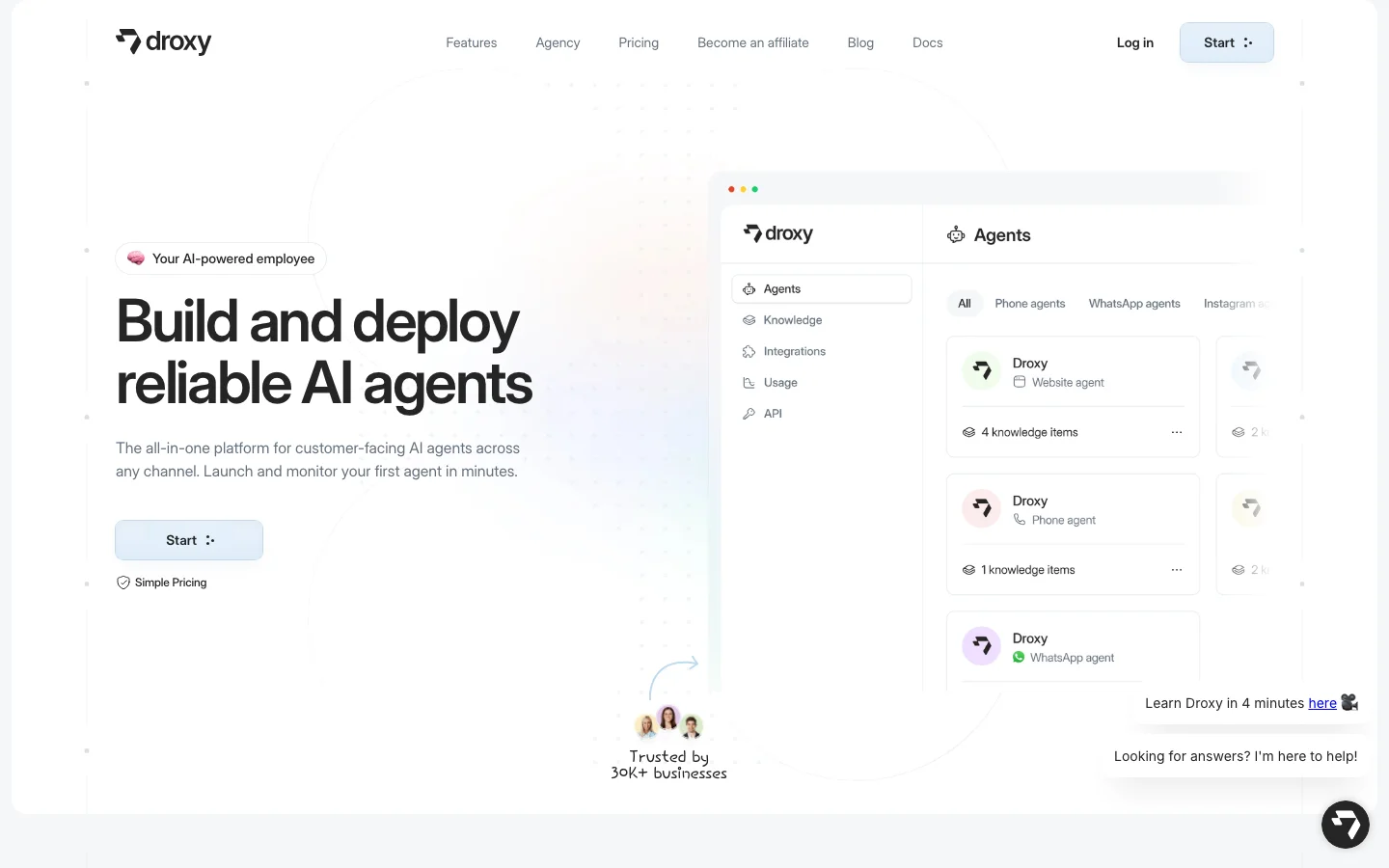
Droxy AI does something most chatbot builders don't: it bundles an AI phone agent alongside website chat, WhatsApp, Instagram DMs, and comment replies. For an HVAC company, a legal office, or a health practice that fields both online inquiries and inbound phone calls, handling everything from one platform is a genuine operational advantage.
You train the AI by connecting your website URL, PDFs, Google Drive, or YouTube videos, and automatic sync keeps the agent current when your content changes. The platform supports 95+ languages and lets you choose between GPT-4o, Claude 3.5, and Gemini models - a flexibility most no-code builders don't offer.
The limitations are volume-specific. The Basic plan at $16/month caps you at 30 phone call minutes and 100 comment replies per month. A moderately busy service business will burn through that in days. The Advanced plan at $80/month (175 call minutes, 500 comment replies) is the realistic starting point for most.
The caveat we need to flag: Droxy claims 30,000+ business customers, but its organic community footprint is nearly nonexistent. Chatbase has multiple independent Reddit comparison threads. Droxy has almost none. For a platform at that stated scale, the absence of grassroots user discussion is worth weighing. A public data privacy question about whether conversation data is used for model training also went unanswered.
Good for: Service businesses in phone-heavy verticals (trades, healthcare, legal, automotive) that want one platform handling web, voice, and social messaging. Not for: High-volume call operations on the Basic plan, or buyers who need a strong independent user community as a trust signal before committing.
3. Tidio (Lyro) - The SMB Sweet Spot
Category: Hybrid AI + live chat Price: Free tier (10 operators, 100 visitors/mo). Starter ~$29/mo, Growth ~$59/mo, Tidio+ custom.
Tidio is the tool in this list that most consistently earns genuine praise from people who have actually used it in production. Its AI agent, Lyro, handles repetitive questions autonomously and hands off to human agents when it hits something it can't answer. Unlike most competitors, Lyro is included in paid plans rather than sold as an expensive add-on.
The community feedback is specific and credible:
"Set up in 2 hours. Abandoned cart recovery works (15% recovery rate)." - r/AI_Agents, DTC brand test
"I had the chat widget running and a basic bot handling FAQs within like an hour." - r/AIAssisted
"The AI agent alone has probably saved us 15-20 hours a week on basic questions." - r/AIAssisted
The free plan is genuinely generous - 10 operators and enough to properly evaluate the platform before spending anything. That matters in a category where most free tiers are deliberately crippled to force upgrades.
The weakness is specific: product recommendation AI is weak. The same DTC brand tester who praised the abandoned cart recovery rated the product recommendation engine as "brain-dead" and noted you can't fix the algorithm. If you run an ecommerce store where "customers who bought X also want Y" suggestions are a revenue driver, Tidio won't replace a purpose-built recommendation engine.
Lyro conversations have a monthly limit (50 free, then paid add-ons), so high-volume stores need to budget for that separately.
One signal worth noting: Tidio is frequently cited in r/thesidehustle (350 upvotes) as a tool that freelancers use to build AI chatbot services for local businesses. When a platform becomes a small business itself for freelancers, that's a strong trust indicator.
Good for: Small-to-medium ecommerce stores that want AI automation without abandoning human support. Shopify and WooCommerce stores. Businesses that need live chat and AI without paying for two separate products. Not for: Stores where product recommendation quality is a primary revenue driver, or businesses that need enterprise-level analytics and reporting.
4. Intercom Fin - When You've Outgrown "I Need a Chatbot"
Category: Enterprise AI customer service platform Price: Essential $29/seat/mo, Advanced $85/seat/mo, Expert $132/seat/mo (annual). Fin AI Agent: $0.99/resolution on all plans.
Intercom Fin is not competing with Chatbase or Tidio. It's for companies that have moved past "I need a chatbot for my website" to "I need a customer service platform for my team." If you have five or more support agents and need routing, ticketing, knowledge base management, and AI handling the first line of response, this is the tier where those needs are met.
Fin is Intercom's AI agent - it handles support conversations autonomously and escalates to human agents when needed. The multilingual support is cited as the best in the category:
"Fin is really helpful and supports non-English languages. You can also build a small help center inside the chatbot." - r/nocode
The pricing model is where it gets complicated. Every plan charges per seat AND Fin charges $0.99 per AI resolution on top of that. For a support team handling 1,000 AI resolutions per month, that's $990 in Fin charges alone - before seat costs. At 5,000 resolutions, you're at nearly $5,000/month just for the AI layer.
That math is not hidden, but it's not obvious from the pricing page either. A five-person support team on the Essential plan handling 2,000 AI resolutions per month would pay: (5 x $29) + (2,000 x $0.99) = $145 + $1,980 = $2,125/month. That's a different conversation than "$29/seat/month."
One honest internal question from an r/intercom user captured the enterprise AI ROI challenge: "Has automation actually lowered support cost? Leadership keeps asking for ROI but like adding more flows just means more maintenance."
Good for: Growing companies with 5+ support agents where routing, tracking, and team management matter as much as AI quality. Teams that need multilingual support. Companies already using Intercom's other products. Not for: Solo operators or small teams. Anyone on a tight budget - the per-resolution pricing accumulates faster than most buyers expect.
5. Botpress - The Developer Option
Category: Open-source chatbot development platform Price: Pay-as-you-go (free, $5/mo AI credit), Plus $79/mo, Team $445/mo, Enterprise custom.
Botpress is not for the typical small business owner reading this guide, and being upfront about that is more useful than pretending otherwise. It's a visual flow builder where developers design conversation logic in a node-based editor, connect AI knowledge bases, and deploy to any channel. Both self-hosted and cloud options are available.
The community on r/botpress is small but technical - questions about API calls, database connections, knowledge base querying. No significant complaint threads. Users who have trouble post technical questions, not product reviews. That's actually a healthy signal for a developer tool.
The freelancer angle is real: one Reddit post with 363 upvotes described building a real estate agent chatbot on a Botpress-adjacent platform and having 57 paying customers within months. The dev-tier chatbot builder market has a legitimate service business model.
The DTC brand test rated the comparable developer tier (Voiceflow) as: "Powerful if you code. Built custom logic that actually works. Took 40 hours. Non-technical people will suffer. Rating: 8/10 for devs, 2/10 for everyone else." Botpress occupies the same space.
Good for: Developers and technical teams who need custom conversation logic, multi-step workflows, or integrations that no-code tools can't support. Agencies building chatbot services for clients. Teams who want to self-host for data control. Not for: Non-technical founders or small business owners who need something working in an afternoon without writing code.
6. CustomGPT - When "Where Did the AI Get That?" Matters
Category: Enterprise RAG chatbot Price: Standard ~$89-99/mo, Premium ~$449-499/mo, Enterprise custom. 7-day free trial.
CustomGPT is the most interesting tool in the doc-upload tier because it attempts to solve the problem that makes the rest of the tier unreliable: it shows you where each answer came from. Citation transparency - the ability to trace every AI response back to a specific source document - is genuinely rare in this category and genuinely useful for businesses where accuracy is non-negotiable.
A B2B SaaS company building compliance software described the exact moment this matters:
"Chatbase: Got something running same day. But after a week of testing the answers started drifting. Asked it something about our enterprise tier and the answer was kinda right but kinda not? And there's no way to see WHERE it pulled the answer from which stresses me out." - r/nocode
That poster was actively evaluating CustomGPT specifically because of the citation feature. When your chatbot is answering questions about legal compliance, medical protocols, or enterprise software licensing, "kinda right but kinda not" is not acceptable.
The limitation: for dynamic product catalogs and ecommerce, CustomGPT is grouped with Chatbase and Dante AI by users who tested all three. The citation advantage matters less when the underlying problem is product spec hallucination, not document retrieval. CustomGPT's sweet spot is static, authoritative content - legal documents, compliance documentation, technical knowledge bases - where the source material is well-structured and rarely changes.
Good for: B2B SaaS companies with technical documentation, compliance-heavy industries (legal, medical, financial), internal knowledge base tools. Businesses where "where did the AI get that?" is a hard requirement. Not for: Ecommerce stores with dynamic product catalogs, or businesses looking for a general-purpose customer support bot.
7. Dante AI - The Chatbase Alternative
Category: No-code FAQ bot Price: Starter ~$12-19/mo, Pro ~$99/mo, Business ~$249-299/mo, Enterprise custom.
We'll be direct: Dante AI is functionally equivalent to Chatbase in the eyes of real users who have tested both. The same DTC brand test that rated Chatbase 3/10 grouped Dante AI in the identical tier with the same verdict.
Dante AI claims media ingestion (images, video content) as a knowledge source, which differentiates it from Chatbase's text-only approach. It also enters at a potentially lower price point. Beyond that, the independent community signal is nearly nonexistent - almost no Reddit discussion, no standout feature that users specifically praise.
That doesn't make it a bad product. It makes it a product without a differentiated reputation. If you've evaluated Chatbase and want a similar tool at potentially lower cost, Dante AI is worth a trial. If you're reading this guide looking for a recommendation, one of the tools above will likely serve you better.
Good for: Users who want a Chatbase-equivalent experience at a potentially lower price, or who specifically need media/image content as a knowledge source. Not for: Anyone looking for a chatbot that's meaningfully different from the doc-upload tier.
The Hallucination Problem: The Thing Nobody Puts on Their Landing Page
Here is the uncomfortable truth about AI chatbots in 2026: most of them hallucinate under real-world conditions, and the vendors do not talk about it.
The DTC brand test that we've referenced throughout this guide documented it bluntly:
"Told a customer our waterproof jacket was 'possibly water-resistant.' Can't fix specific errors. Just upload more docs and hope harder."
This is not a one-off. It's the defining limitation of the doc-upload chatbot tier. You train the bot on your content, the bot encounters a question that's slightly outside what your documents cover, and instead of saying "I don't know," it guesses. Confidently. Incorrectly.
The tools in this guide handle this problem differently:
- CustomGPT shows citations for every answer - you can at least see where the AI pulled its response from and catch errors before customers do.
- Tidio (Lyro) has built-in human handoff - when the AI isn't confident, it routes to a human agent instead of guessing.
- Botpress lets developers build conditional logic - you can create explicit rules for how the bot handles edge cases rather than relying on RAG retrieval alone.
- Chatbase, Dante AI - no documented mechanism to control hallucinations beyond uploading more documents. Upload and hope.
- Droxy AI - offers model selection (GPT-4o, Claude 3.5, Gemini) which can improve accuracy, but no specific hallucination control mechanism documented.
- Intercom Fin - sources from a structured knowledge base, which reduces but does not eliminate hallucination risk.
If accuracy matters to your business - and if a chatbot is talking to your customers, it should - this is the factor that should weigh heaviest in your decision. Not the setup speed. Not the pricing tier. Whether the tool has a mechanism to handle the moments when the AI gets it wrong.
How to Choose: The Decision Framework
If the comparison table and seven tool reviews feel like a lot, here's how to simplify it:
"I need a chatbot on my website by end of day." Start with Chatbase. It's the fastest to deploy and the most documented. Know that you may outgrow it - that's normal.
"I need AI support and human backup for my online store." Tidio. The hybrid model is the right architecture for ecommerce where customers expect real help when the bot can't answer.
"I run a service business with phone calls, web chat, and social DMs." Droxy AI. Only option in this tier bundling all three channels.
"I need my chatbot to never make things up - accuracy is non-negotiable." CustomGPT for citation transparency, or Botpress if you have dev resources to build explicit conversation logic.
"I have a growing support team and need routing, ticketing, and AI together." Intercom Fin. Budget for the per-resolution costs.
"I have developers who want full control over conversation flows." Botpress. Expect a 40+ hour setup for custom logic. Worth it if you need it.
"I want a cheaper Chatbase." Dante AI. Similar product, potentially lower price, less brand recognition.
Our Ranking
Based on research, real user feedback, and honest assessment of where each tool actually delivers:
- Tidio (Lyro): Best overall for small business. Hybrid model solves the right problem.
- CustomGPT: Best for accuracy-critical use cases. Citation transparency is a real differentiator.
- Chatbase: Best for getting started fast. Know the credit ceiling.
- Droxy AI: Best for multi-channel service businesses. Verify plan limits for your volume.
- Botpress: Best for developers. Not for everyone, but excellent for its audience.
- Intercom Fin: Best for growing teams. Budget carefully for per-resolution costs.
- Dante AI - Functional Chatbase alternative. Limited independent signal.
Frequently Asked Questions
What is the best AI chatbot for a website in 2026? For most small businesses, Tidio (Lyro) is the best AI chatbot for a website in 2026 because its hybrid AI + human handoff model handles edge cases that pure AI bots hallucinate through. If you need to get live today with minimal setup, Chatbase is the fastest starting point.
How much does an AI chatbot builder cost? AI chatbot builders range from free tiers to enterprise pricing. Entry-level plans start around $12-19 per month (Dante AI, Chatbase). Mid-tier options like Droxy AI start at $16/month on a flat monthly model. Enterprise platforms like Intercom Fin add per-seat and per-resolution fees on top of base pricing.
What is Chatbase and is it worth it? Chatbase is a no-code AI chatbot builder that lets you upload documents and deploy a website chatbot in minutes. It is worth it for low-volume FAQ deflection. At scale, the credit-based pricing model and lack of hallucination controls push most users to alternatives.
Can an AI chatbot replace live chat on my website? For straightforward FAQ queries, yes. For complex customer issues, no. The tools that work best in 2026 use a hybrid approach - AI handles the volume, humans handle the edge cases. Tidio and Droxy AI both support this model.
What is Droxy AI? Droxy AI is a multi-channel AI agent that bundles website chat, AI phone calls, WhatsApp, Instagram DMs, and comment replies into one platform. It is the only chatbot builder in this tier that handles phone calls natively, making it a strong fit for service businesses.
What We Checked
We don't rely on vendor marketing or press releases. This guide is built on community feedback from Reddit (r/AI_Agents, r/nocode, r/AIAssisted, r/SaaS, r/ChatGPT, r/thesidehustle), pricing data verified from source pages and JSON-LD structured data, and real user test results - particularly the DTC brand chatbot comparison that tested six platforms head-to-head and documented the results publicly.
All pricing in this guide was verified as of March 2026. Chatbot pricing changes frequently. Confirm current rates at each vendor's pricing page before committing.
For the full review of each tool, visit the AI chatbot builders category on Belreos. For a broader look at AI tools for small business, we cover twelve categories beyond chatbots.