Gemini 4 Neon, Claude Opus 5.5 and OpenAI Codex are three ways to buy AI coding help on a subscription, and none of the three vendors says exactly how much work a plan covers. Each sells an allowance, not a number. If you code most days, pick the plan whose limit structure matches your week, not the one with the lowest sticker price. If you code a few hours a week, any entry plan will probably do and this comparison matters less.
This is a research piece. We read the vendors' pricing and help pages on 2026-11-26 and collected public user reports. Apart from the Claude Ultra plan we pay for, we did not run these plans ourselves, and the limits box near the end spells out what that means.
The short answer
Heavy daily users should look first at the plans with no five-hour window. Claude Ultra drops it for verified accounts, and Codex Pro currently has none. Everyone else is choosing between a five-hour window plus a weekly cap, and the weekly cap is the one that ends your week early.
Neon is the model with the loudest complaints about burning quota on Google's Pro plan right now. Google says changes to caching (reusing work the model has already done) are already giving it more headroom. Codex is about to change shape in December. We think Claude has the clearest published structure of the three. If you want the best coding AI for the money, you can't read it off a price list, because the unit you are buying is hidden.
Why the plan price tells you little
No vendor in this comparison publishes an exact token (the chunk of text a model counts and bills by) or message quota for its subscription tiers. The one exception is OpenAI, which gives rough message ranges for Codex, and it says outright that they are not fixed limits.
So "$20 a month" buys a different amount of work at each company, and the same company can change that amount without changing the price. Google, for one, said on 2026-11-26 that Neon gets about 75% more usage on the same plan after caching changes.
Cost per task doesn't solve it either. Artificial Analysis's Coding Agent Index, read on 2026-11-26, lists Antigravity CLI with Neon at about $7 a task and Codex with GPT-6.2 Astra at about $5. Those are pay-per-use (API) costs for a benchmark task. They say nothing about how long a subscription allowance lasts.
Gemini 4 Neon in Antigravity
Google's Antigravity has a free tier, and Neon isn't on it. The free tier gets Hydrogen, Google's cheaper model, under a weekly quota. Neon and Carbon are listed for Google AI Pro, Ultra and Business.
Google puts no number on that free Hydrogen quota, so its plan pages can't tell you how much work a free week covers. On Google's API price list, Hydrogen costs $1.50 per million input tokens against $3 for Neon.
Google describes the Pro quota as "high", with a five-hour refresh plus a weekly limit, and gives no numbers. Ultra runs $100 to $200 a month, per Google's May 2026 announcement. The two sizes carry 5x and 20x Pro's quota. Google's Antigravity pages don't list the Pro price.
The complaints are specific. One user on X, @Seikojinsama, wrote that a single project burned 96% of the weekly quota. It took a day and a half. Another, @Reclyo, said one window eats 25 to 35% of the weekly limit. Those are single-user reports, but there were many of them on 2026-11-26.
Google's answer came from the Antigravity lead, Varun Mohan, who said the 75% gain arrived through caching and tooling changes. That is a vendor statement. It may fix the complaint for some users and not for others, and the only way to know is to watch your own weekly meter.
One narrow warning if you like tracking usage in third-party tools. T3 Code says Google asked it to remove Antigravity usage-limit reporting for terms-of-service reasons, and that using Antigravity through its official protocol is fine.
Claude Code and Opus 5.5
Claude Code is Anthropic's coding agent, and it needs a paid plan. Claude Free has no Claude Code and no Opus. That makes Claude Code pricing simple to state and hard to compare: Pro is $20 a month, or $17 on annual billing. Max is $100.
Pro and Max have a five-hour limit plus a weekly limit. Ultra costs $200, and verified Ultra accounts have a weekly limit only. Claude and Claude Code draw from the same pool, so a long chat in the app eats into the coding you planned for the afternoon.
Anthropic announced Opus 5.5 on 2026-09-22 at $4 per million input tokens, against $5 for Opus 5. The same post raised five-hour limits on Pro, Max, Team and seat-based Enterprise plans. Anthropic's post is about the five-hour limits, and Anthropic's support pages don't say which plans include Opus 5.5.
That last gap matters if you were about to buy Pro for Opus. Check the plan page before you pay.
If you want a head-to-head of Claude Code against an editor-first tool, our Claude Code vs Cursor comparison covers the workflow split.
OpenAI Codex and the December merge
OpenAI Codex is OpenAI's coding agent, and it comes with ChatGPT plans. Plus is $20 a month. Pro starts at $100. On Plus, OpenAI's pricing page estimates 17 to 180 GPT-6.2 Sol messages per five-hour window, against 6 to 50 for GPT-6.2 Astra. The page says these are not fixed limits and that weekly limits may also apply.
Codex is the only one of the three that gives you any range at all. The spread is wide enough that it works as a warning more than a plan: a heavy Astra day likely sits near the bottom of the range.
In December, things change. OpenAI's help page says Plus, Pro and Business allowances will be shared across ChatGPT and Codex, measured in tokens, with Instant chat excluded. A small group of users may see the change before December. The page doesn't give the size of the shared pool, and it isn't live for everyone yet.
What it means for you: if you use ChatGPT beyond Instant chat and also run Codex, you'll be spending one allowance, not two. Reading the model tiers in our explainer on OpenAI's Sol, Terra and Luna models will help you guess which requests cost the most, since OpenAI says larger models and more complex tasks use more.
A user on X posted an email attributed to OpenAI saying some GPT-6.2 Astra and Sol requests in Codex had used less allowance than intended, and that users may reach their limit sooner after the correction. The subscription price wasn't changing. It's user-posted, so treat it as unconfirmed.
Cursor sits inside the X subscription
Cursor pricing now lives inside the X Subscription sold by X Subscription Corp. The plans run from Plus at $8 to Ultra at $200, with Premium and Super in between. They share one weekly pool with Grok features.
Models from other vendors aren't covered by the monthly price. Cursor bills them at the vendor's pay-per-use (API) list price. For a Neon user that means $3 per million input tokens, and Opus 5.5 costs $4 for the same amount.
So Cursor is a different kind of buy. The plan covers Cursor and Grok, and when you pick Neon or Claude inside it, you pay for tokens on top. One user on X, @CHYchenhongyu, said an upgrade to Premium for "2x usage" burned 44.2% of the allowance in a day. That is one person's report, but it fits the worry that a pool shared across products can drain faster than the plan name suggests.
For the deal behind this, see our read on how developers reacted to the Cursor and SpaceX deal. For the editor itself, see the Cursor review. If you'd rather compare it with a different editor assistant, GitHub Copilot is the usual alternative, and our Cursor vs GitHub Copilot post goes through it.
The plans side by side
The table keeps each vendor's official limit structure in one place.
| Plan family | Entry paid plan | Top tiers | Limit structure |
|---|---|---|---|
| Google (Antigravity, Neon) | Google AI Pro | Ultra $100 and $200 | Five-hour refresh plus weekly limit |
| Anthropic (Claude Code, Opus 5.5) | Pro $20 | Max $100, Ultra $200 | Five-hour plus weekly; verified Ultra weekly only |
| OpenAI (Codex) | Plus $20 | Pro $100, $200, $500 | Five-hour estimates, weekly may apply; Pro has no five-hour limit now |
| Cursor (X Subscription) | Plus $8 | Super $100, Ultra $200 | One weekly pool shared with Grok |
What a working day looks like on each
A working day is longer than one five-hour window, so on Google, Claude and Codex you'll usually cross at least one reset between morning and evening. That sounds friendly, and it is, until the weekly limit arrives. We suspect that for anyone coding five days a week, the weekly cap decides which plan you need, and the five-hour window only decides how your day feels.
Our read, from the plan structure and the reports above:
- Heavy daily agent work: the no-five-hour options (verified Claude Ultra accounts, Codex Pro) remove one limit, and nothing else is promised.
- Mixed chat and code on OpenAI: watch December. Your ChatGPT use beyond Instant chat will start to count.
- Neon on Google AI Pro: budget for hitting the weekly cap early until Google's caching changes show up in your own meter.
- Editor-first work with a model of your choice: Cursor's plan covers the editor, but model tokens are extra.
We pay for Claude Ultra only, and as heavy users we hit its weekly limit every week.
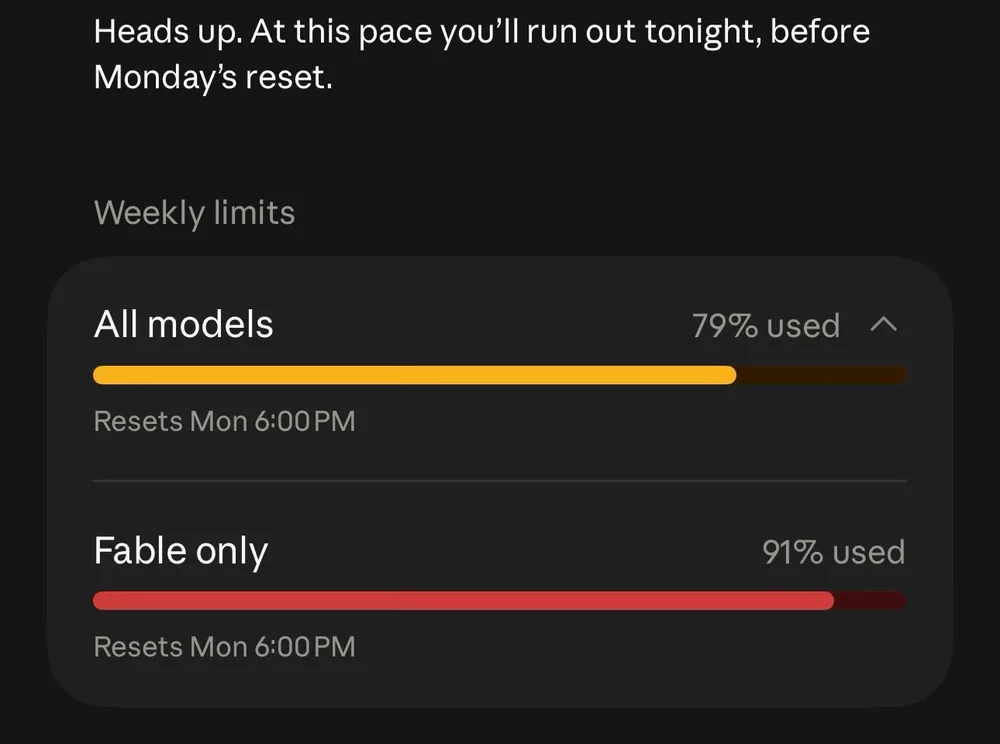
Our own Claude usage on a Thursday: 79% of the all-models weekly limit and 91% of the Fable-only limit used, resetting Monday at 6:00 PM. Fable is a Claude model with its own weekly cap.
How we researched / limits
- Mostly research. We didn't test Neon, Opus 5.5, Codex or Cursor. Apart from our own Claude usage screenshot above, everything here comes from vendor pricing pages, help pages, official posts and public user reports read on 2026-11-26.
- User reports are single posts on X. They show a pattern, not a measured rate. We didn't have Reddit threads for this piece.
- Opus 5.5 benchmark position. We didn't read a coding-index score for Opus 5.5, so this article makes no ranking claim for it against Neon.
- Plans move fast. The OpenAI December change isn't live for everyone, and Google says it adjusted Neon usage this week. Check each pricing page before you buy.
FAQ
What are the usage limits on Claude Code, Codex and Gemini 4 Neon?
None of the three vendors publishes an exact token or message quota for its subscription tiers. Claude and Antigravity use a five-hour window plus a weekly limit, and OpenAI gives rough Codex message ranges per five-hour window that it says aren't fixed.
How much does Claude Code cost?
Claude Code needs a paid Claude plan. Pro is $20 a month ($17 on annual billing), Max is $100 and Ultra is $200. Claude and Claude Code share the same limits.
Is Codex limited the same way as ChatGPT?
Starting in December, OpenAI says Plus, Pro and Business allowances are shared across ChatGPT and Codex and measured in tokens, with Instant chat excluded. OpenAI says a small group may see it earlier, so it isn't live for everyone yet.
Can I use Gemini 4 Neon for free?
Not in Antigravity. Its free tier includes Hydrogen but not Neon or Carbon. Neon is listed for Google AI Pro, Ultra and Business.
Is Cursor's price all-inclusive?
No. Cursor's plans share a weekly pool with Grok features, and models from other vendors are billed separately at API list price.
What is the best coding AI for heavy daily use?
We can't rank it from research alone. Weigh the limit structure first: Claude Ultra for verified accounts and Codex Pro currently have no five-hour window, and the weekly allowance behind each is not published. Our AI coding category lists the tools we've reviewed.